

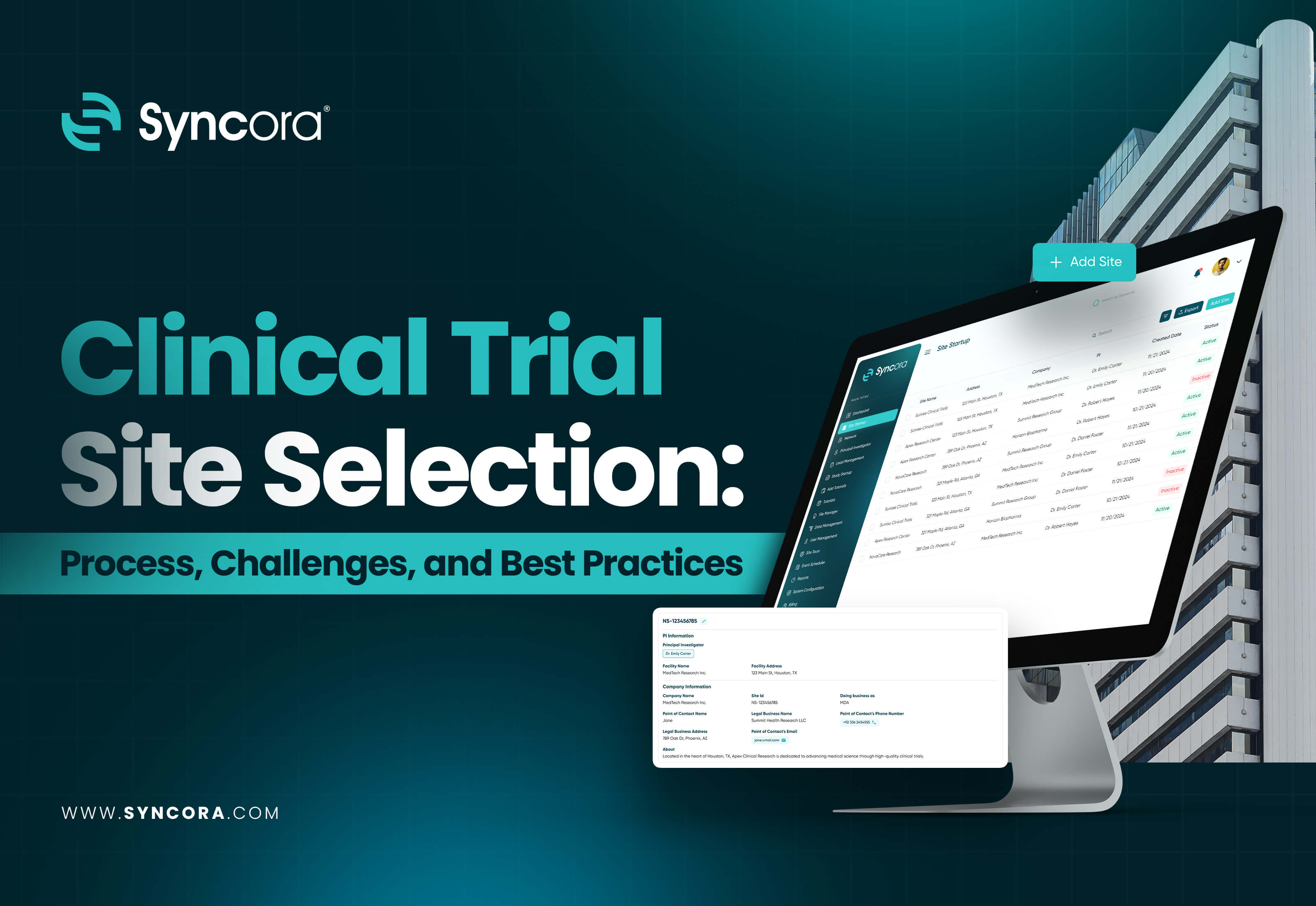
Selecting the right site is one of the most critical steps in clinical research. Clinical trial site selection directly impacts recruitment speed, data quality, regulatory compliance, timelines, and overall study costs. Even a well-designed protocol can face delays if the chosen sites lack the right patient population, infrastructure, or operational readiness.
However, the current clinical trial site selection process still presents challenges. Low investigator engagement, overestimated recruitment projections, and limited data-driven decision-making often result in underperforming sites. As trials grow more complex and globally distributed, site selection requires a more structured, strategic approach.
In this blog, we’ll explore the key factors to consider during clinical trial site selection, common challenges that affect performance, and best practices to improve outcomes.
What Is Clinical Trial Site Selection?
Clinical trial site selection involves systematically evaluating and selecting research sites where a clinical study will be conducted. These sites may include hospitals, academic medical centers, private research institutions, and community-based clinics.
The objective of site selection for clinical trials is to identify locations that can:
- Recruit eligible participants efficiently
- Maintain regulatory compliance
- Ensure high-quality data collection
- Meet projected enrollment timelines
- Support patient retention
The clinical trial site selection process typically involves feasibility assessments, site qualification, regulatory review, budget alignment, and activation planning. In global trials, this process may travel to multiple countries, fasten study startups and require careful coordination across regulatory frameworks.
However, this strategic clinical trial site selection is not simply about choosing sites with the largest patient pools. It requires evaluating infrastructure, staffing, competing trials, investigator experience, and operational readiness.
Why Clinical Trial Site Selection Matters
Poor clinical trial site selection is a leading cause of trial delays and budget overruns. Studies frequently underperform because sites overestimate recruitment capacity or underestimate operational complexity.
Effective site selection for clinical trials influences:
- Recruitment Performance: Sites with proven enrollment history and access to target populations reduce screen failure rates and recruitment delays.
- Regulatory Compliance: Experienced sites are better equipped to navigate IRB/EC submissions, inspections, and documentation requirements.
- Budget Management: Delays in activation or low enrollment rates can significantly inflate trial costs.
- Data Quality: Well-trained staff and established SOPs support accurate and consistent data entry.
- Patient Retention: Sites with strong patient engagement strategies improve adherence and reduce dropout rates.
A structured clinical trial site selection process helps mitigate these risks by combining data-driven insights with operational assessments.
Step-by-Step Clinical Trial Site Selection Process
A systematic approach ensures that clinical trial site selection decisions are based on measurable criteria rather than assumptions.
Step 1: Protocol Review and Feasibility Assessment
The clinical trial site selection process begins with protocol analysis. Sponsors assess whether inclusion and exclusion criteria align with real-world patient availability.
Key activities include:
- Country and regional feasibility analysis
- Epidemiology review
- Site feasibility questionnaires
- Historical enrollment performance analysis
- Competitive landscape assessment
Feasibility bias is a common risk. Sites often overestimate their recruitment capacity. Data validation and benchmarking reduce this risk during clinical trial site selection.
Step 2: Site Identification
During site selection for clinical trials, sponsors identify potential investigative sites using:
- Internal performance databases
- CRO networks
- Investigator relationships
- Conference engagement
- Therapeutic area expertise
Performance metrics such as past enrollment rates, screen failure percentages, and audit history play a major role in modern clinical trial site selection strategies.
Step 3: Site Qualification and Evaluation
This phase of the clinical trial site selection process involves a deeper operational review.
Activities typically include:
- Pre-study questionnaires
- Site Qualification Visits (SQVs)
- Infrastructure review (labs, pharmacy, equipment)
- Staff experience evaluation
- SOP and quality system review
- GCP compliance history
- At this stage, sponsors should apply a structured clinical trial site selection checklist to ensure consistent evaluation across all potential sites.
Step 4: Regulatory and Contractual Review
Regulatory readiness can significantly influence timelines. Delays in IRB approval or contract negotiation often postpone site activation.
Important considerations include:
- Ethics committee timelines
- Contract negotiation efficiency
- Budget alignment
- Insurance and indemnification documentation
- Country-specific compliance requirements
An organized clinical trial site selection process incorporates regulatory intelligence early to prevent bottlenecks.
Step 5: Final Site Selection and Activation
Once evaluations are complete, sponsors conduct a comparative analysis using risk-scoring models. Selection factors may include:
- Recruitment potential
- Operational readiness
- Cost efficiency
- Previous performance metrics
- Geographic diversity
Final activation includes regulatory submission tracking, site initiation visits, and staff training.
A structured approach to clinical trial site selection ensures activation timelines are predictable and measurable.
Clinical Trial Site Selection Checklist
A standardized clinical trial site selection checklist supports consistent, objective decision-making. Key components include:
Patient Population
- Availability of eligible participants
- Access to diverse demographics
- Competing trials in the same indication
Investigator Experience
- Therapeutic area expertise
- Previous trial performance
- Publication history
Operational Infrastructure
- Dedicated research coordinators
- Pharmacy capabilities
- Laboratory certification
- Technology and EDC experience
Regulatory Track Record
- Inspection history
- IRB turnaround times
- Compliance documentation
Financial and Contractual Stability
- Budget transparency
- Payment cycle reliability
Using a robust clinical trial site selection checklist strengthens risk management within the broader clinical trial site selection process.
Common Challenges in Clinical Trial Site Selection
Even with structured planning, site selection for clinical trials presents several challenges.
- Overestimated Recruitment Projections: Sites may provide optimistic enrollment forecasts without validating the data.
- Regulatory Delays: Country-specific requirements and variability in ethics committees can slow approvals.
- Limited Patient Diversity: Failure to prioritize diverse populations can impact generalizability and compliance expectations.
- Competing Trials: High-research-activity regions may reduce available participant pools.
- Budget Misalignment: Unrealistic budget negotiations delay activation.
- Operational Capacity Constraints: Limited staff bandwidth can hinder performance.
Addressing these risks early in the clinical trial site selection process minimizes downstream delays.
Best Practices to Improve Clinical Trial Site Selection
To optimize clinical trial site selection, sponsors and CROs should adopt proactive strategies:
- Use Data-Driven Analytics: Leverage historical performance data and predictive modelling.
- Validate Feasibility Data: Cross-check site projections against real-world metrics.
- Apply Risk-Based Scoring Models: Standardize decision criteria across sites.
- Prioritize Experienced Research Staff: Dedicated coordinators improve trial efficiency.
- Build Long-Term Site Relationships: High-performing sites benefit from repeat collaborations.
- Continuously Refine the Clinical Trial Site Selection Checklist: Update criteria based on lessons learned from previous studies.
An optimized clinical trial site selection process reduces uncertainty and enhances predictability.
Technology and Innovation in Site Selection
Technology is transforming clinical trial site selection.
Modern tools include:
- AI-powered feasibility platforms
- Real-world data integration
- Predictive enrollment modelling
- Performance dashboards
- Geographic heat mapping
Digital transformation allows sponsors to refine site selection for clinical trials with greater precision and transparency. These innovations strengthen the overall clinical trial site selection process and improve enrollment forecasting accuracy.
Conclusion
Effective clinical trial site selection is foundational to study success. From feasibility assessment to final activation, each stage of the clinical trial site selection process plays a critical role in determining recruitment performance, regulatory compliance, and budget control. By combining data-driven analytics, structured evaluation methods, and a comprehensive clinical trial site selection checklist, sponsors can significantly reduce operational risk.
As clinical research becomes more complex and competitive, strategic site selection for clinical trials is no longer optional; it is essential. At Syncora, we help sponsors and CROs streamline site identification, feasibility evaluation, and activation with data-driven insights and operational expertise. Organizations that invest in refining their clinical trial site selection process will be better positioned to accelerate timelines, improve data quality, and deliver successful clinical outcomes.


