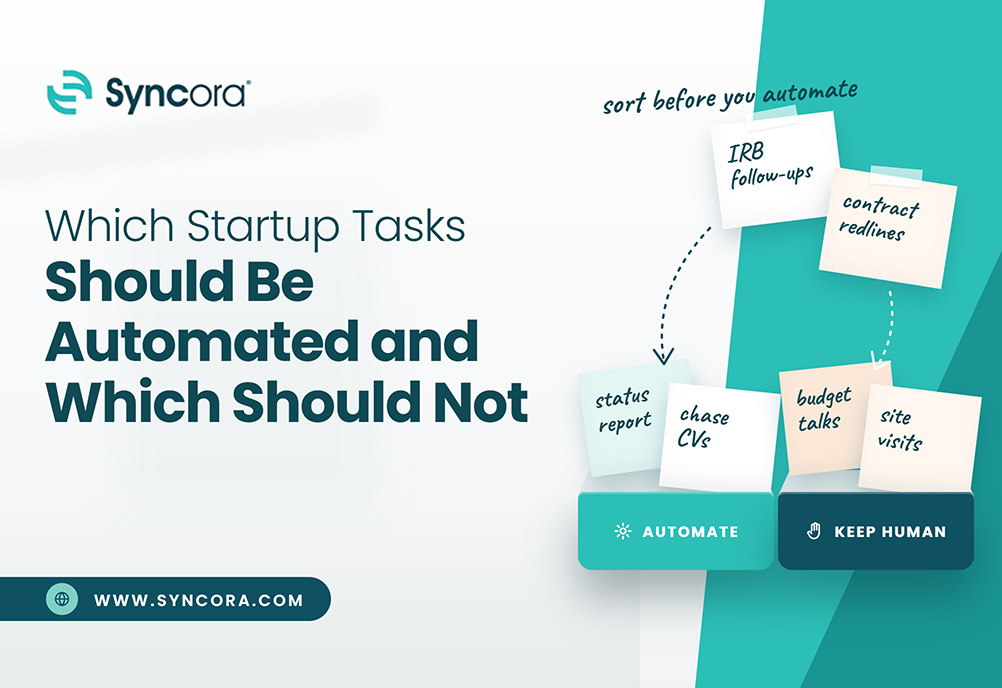
Not every startup task belongs on autopilot. Some steps need a human eye no matter how advanced your systems become.
Key Takeaways:
- Automation works best for repetitive tasks like tracking, reminders, and document routing
- Complex judgment calls, like protocol interpretation, still need human review
- Human in the loop review protects quality even in automated workflows
- Clinical trial automation reduces delay but does not remove the need for oversight
- Choosing the wrong tasks to automate can create new bottlenecks instead of solving them
Quick Answer:
Clinical trial automation works best for repetitive, rules-based tasks such as status tracking, document routing, and reminder emails. Consequently, coordinators save hours each week on administrative work. However, tasks that require clinical judgment, protocol interpretation, or nuanced communication with sites still need human review. Therefore, the study startup process runs most smoothly when automation handles volume and people handle complexity. Sponsors who automate everything without a human in the loop often see new errors appear, while sponsors who automate too little miss out on real time savings.
Introduction
Study startup involves dozens of moving parts, from document collection to regulatory submissions. Naturally, teams look for ways to speed things up. Automation sounds like an easy answer, but not every task benefits from it equally. Some tasks run faster and cleaner with automation. Others still need a person to catch nuance a system might miss. This article breaks down which study startup tasks are strong automation candidates, which ones still need human review, and how to strike a workable balance between the two.
What Makes a Study Startup Task a Good Fit for Automation?
Automation works best on tasks that follow clear, repeatable rules. Status updates, deadline reminders, and document routing all fit this pattern well. Similarly, tracking which site has submitted which document benefits from automated checklists rather than manual spreadsheets.
Consequently, these tasks free up coordinator time for work that actually requires judgment. Automating clinical trial documentation in this way reduces the risk of a missed deadline slipping through the cracks. The task itself does not change, but the speed and consistency improve.
Which Study Startup Tasks Still Require Human Judgment?
Not every task fits neatly into a rules-based system. Protocol interpretation, for example, often requires context that a system cannot fully capture.
This is not just an operational preference. The ICH E6(R3) Good Clinical Practice guideline, takes a risk based and proportionate approach that still places responsibility for trial oversight on qualified staff, even as it encourages more efficient tools and technology.
Additionally, communication with sites about unusual circumstances benefits from a human voice rather than an automated message. Therefore, tasks involving nuanced decision making should stay with experienced staff.
Automation can still support these tasks by organizing information, but the final judgment call belongs to a person. This distinction matters more than it might seem at first glance.
How Does Clinical Trial Workflow Automation Handle Document Collection?
Document collection is one of the clearest automation wins in the study startup process. Manual collection often involves email chains, follow up calls, and lost attachments.
Automated systems, on the other hand, can track submission status, send reminders, and flag missing items without staff intervention. Below is a simple breakdown comparing manual and automated approaches to common startup tasks.
| Startup Task | Manual Approach | Automation Fit |
|---|---|---|
| Document collection | Email and manual tracking | Strong fit |
| Status reminders | Manual follow up calls | Strong fit |
| Regulatory document routing | Spreadsheet updates | Strong fit |
| Protocol interpretation | Staff review and discussion | Human review needed |
| Site relationship communication | Personal outreach | Human review needed |
| Complex query resolution | Investigator judgment | Human review needed |
As the table shows, the clearest automation wins involve volume and repetition, not judgment.
Why Does Human in the Loop Review Still Matter?
Human in the loop review keeps automated systems accountable. Even well designed automation can misread context or flag something incorrectly. Consequently, a person reviewing flagged items catches errors before they affect a site’s timeline.
Furthermore, this review step builds trust with sites and sponsors who want reassurance that a person is still watching the process. Removing human review entirely often creates more problems than it solves, especially in tasks tied to regulatory compliance.
What Happens When Sponsors Automate the Wrong Tasks?
Automating a task that requires judgment can slow things down rather than speed them up. For instance, an automated system might send a generic reminder to a site dealing with an unusual regulatory issue. This can come across as dismissive rather than helpful. Additionally, staff may end up spending more time correcting automated mistakes than they would have spent doing the task manually. Therefore, choosing the right tasks to automate matters as much as the automation itself.
How Can Sponsors Decide Which Tasks to Automate First?
Deciding where to start with automation does not need to be complicated. A few practical questions can guide the decision:
- Does the task follow the same steps every time?
- Does the task involve high volume across many sites?
- Does the task require judgment specific to one site or situation?
- Would a delay in this task create a bottleneck elsewhere?
Tasks that answer yes to the first two questions are strong automation candidates. Tasks that answer yes to the third question usually need to stay with staff, even if automation supports the surrounding process.
How Does Automation Affect Overall Study Startup Costs?
Clinical trial automation does not eliminate cost, but it shifts where time gets spent. Coordinators spend less time on repetitive tracking and more time on tasks that require expertise. Consequently, sites tend to activate faster because bottlenecks caused by manual tracking shrink. However, sponsors should expect an adjustment period as staff learn new systems and workflows. Over time, this adjustment tends to pay off through fewer delays and fewer manual errors during the study startup process.
Frequently Asked Questions
What clinical trial tasks are best suited for automation?
Repetitive, rules-based tasks like status tracking, document routing, and reminder emails are the strongest automation candidates in most study startup processes.
Should protocol interpretation ever be automated?
No. Protocol interpretation requires clinical judgment and context, so it should stay with experienced staff even when supporting tools use automation.
What is human in the loop review?
Human in the loop review means a person checks automated outputs before they are finalized, which helps catch errors automation alone might miss.
Can automating clinical trial documentation reduce startup delays?
Yes. Automating document collection and tracking reduces missed deadlines and manual follow up, which often shortens the overall study startup timeline.
Does automation replace the need for experienced coordinators?
No. Automation handles volume and repetition, while coordinators still manage judgment calls, site relationships, and complex problem solving.
Conclusion
Clinical trial automation offers real benefits, but only when applied to the right tasks. Repetitive work like tracking, reminders, and document routing runs faster and cleaner with automation support. Meanwhile, tasks that require judgment, context, or personal communication still need experienced staff behind them.
Sponsors who understand this distinction tend to see the biggest gains in their study startup process. If your team is weighing where automation fits into your startup workflow, Syncora can help you start with the tasks that create the most repetitive strain on your staff today, while keeping the tasks that protect patients and data quality in human hands.