

Key Takeaways:
- “Missing” startup documentation does not always mean a file was deleted or lost.
- Staff turnover in clinical research can create gaps in ownership, context, and study knowledge.
- A strong study documentation handover transfers context, not just files.
- Clear ownership, version history, task status, and centralized information support continuity.
- Clinical trial documentation management should make study information usable beyond the person who originally managed it.
Clinical trial startup creates more than documents. It creates decisions, deadlines, task ownership, correspondence, approvals, and a working understanding of what needs to happen next. Startup documentation includes records, approvals, correspondence, decisions, task records, and other study information created or maintained while preparing a trial or site to begin study activities.
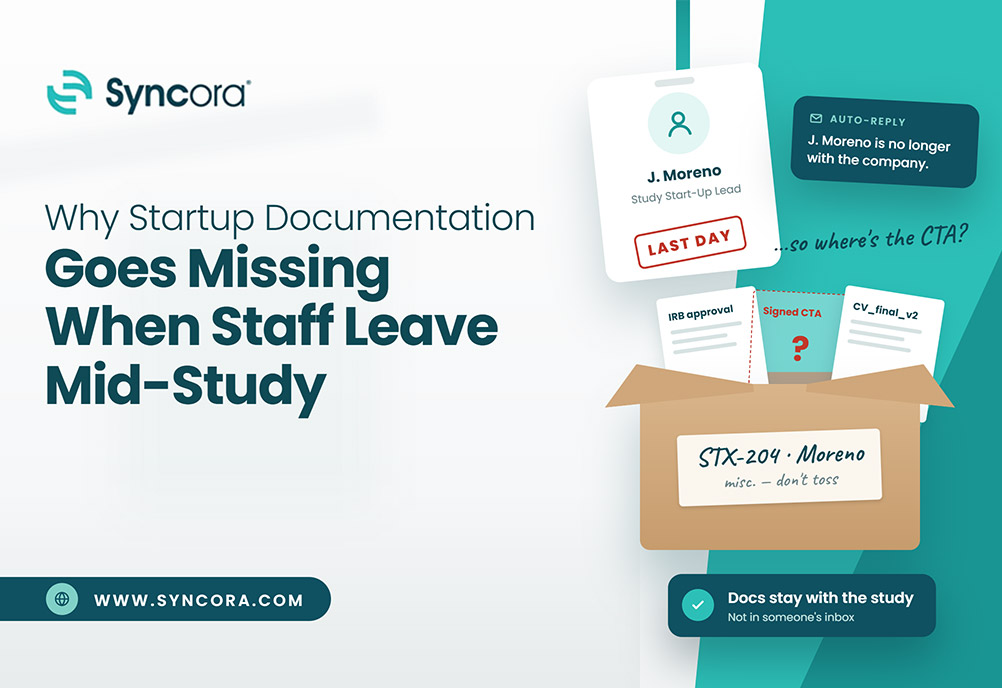
When a staff member leaves mid-study, those files may still exist. What can become difficult to recover is the context around them: why a document was requested, which version is current, who owns the next step, or whether an issue was fully resolved.
Quick Answer:
Startup documentation can become “missing” when a staff member leaves because the files may remain, but their context, ownership, version, and status become unclear. Effective clinical trial documentation management preserves this information so incoming staff can understand what happened, what is pending, and what needs to happen next.
Why Does Staff Turnover Create Documentation Problems in Clinical Research?
Study startup information is rarely kept in one place. A regulatory document may sit in a study folder, an approval may be buried in an email thread, a pending task may be tracked in a spreadsheet, and the reason behind a decision may exist only in someone’s notes.
That setup can work while the same person manages the study every day. But when that person leaves mid-study, the team can discover that having access to files is not the same as understanding the work.
This is why “missing” startup documentation does not always mean a file has disappeared. The document may still exist, but its location, version, ownership, status, or context may no longer be clear.
Research on the clinical research workforce has identified staff turnover in clinical research as an operational challenge, including potential effects on efficiency, stability, and continuity.
For research teams, clinical trial documentation management is therefore about more than document storage. It is about preserving the information and accountability needed to keep startup activities moving when responsibilities change.
The Documents Stay, but the Context Can Leave
Staff turnover does not necessarily mean documents disappear. More often, the knowledge surrounding those documents becomes harder to recover.
A replacement may find a regulatory document but not know why it was requested. They may find several versions without knowing which one is current. They may see a completed task without knowing what decision closed it or an email thread without knowing whether the issue was fully resolved.
A document can tell someone what exists. Context tells them why it exists, what happened, what remains open, and what comes next.
This distinction also aligns with ICH E6(R3), which states that essential records should be identifiable and version controlled when appropriate. It also calls for systems that support appropriate identification, version history, search, and retrieval of trial records.
One Person’s Workflow Can Become the Team’s Knowledge Gap
Startup activities can become dependent on individual workflows when information is spread across email, shared folders, spreadsheets, meeting notes, task lists, and personal working files.
The problem is not simply that an employee leaves. The study may lose the person who knew how those pieces connected.
Without effective clinical trial knowledge transfer, incoming staff may spend time searching, comparing files, and rebuilding timelines instead of continuing the work. While clinical research staff retention can reduce disruption, documentation should not depend on one person remaining in the role.
What Gets Lost in a Study Documentation Handover?
A study documentation handover should transfer the work, not make the next person reconstruct it.
| What may be available | What the replacement still needs to know |
|---|---|
| Study document | Which version is current and why |
| Task list | Who owns each task and what remains open |
| Email history | What decision was made and whether it was resolved |
| Shared folder | Which files are relevant to current work |
| Site information | Current status, issues, and next steps |
| Regulatory records | What is complete, pending, or awaiting action |
| Startup timeline | Which deadlines or milestones are approaching |
This is the difference between information being stored and information being usable. A good study documentation handover connects documents with decisions, responsibilities, timelines, and next actions.
The goal is not to give an incoming employee every file. It is to give them enough context to understand where the study stands without recreating the departing employee’s workflow from scratch.
Why Does Document Ownership Matter When Staff Leave Mid-Study?
Document ownership in clinical trials means clearly assigning responsibility for maintaining, reviewing, updating, or acting on a study record.
Access does not equal ownership. Someone may have access to a study folder without knowing which records they are responsible for or which outstanding activities require action.
When someone leaves mid-study, the incoming team should be able to see who owns each document or activity, what is complete, what is pending, and who needs to act next.
Clear ownership connects documentation with a person or team, a task, a status, and a next action. When responsibilities change, that ownership should change visibly too.
What Does a Single Source of Truth Prevent When Staff Leave Mid-Study?
A single source of truth in clinical trials is a centralized, maintained location where teams can find the current study information, documents, responsibilities, and status they rely on to manage the work.
It may include:
- Current documents and version history.
- Tasks and owners.
- Study milestones and site status.
- Important decisions and updates.
A platform does not automatically become a single source of truth simply because it stores documents. Teams need to consistently maintain and use it as the authoritative reference.
This matters during staff transitions because the incoming team should not have to search multiple systems, inboxes, and folders to reconstruct the current state of startup activities.
How Can Clinical Trial Documentation Management Support Study Continuity?
The goal is not simply to store more documents. It is to make startup information usable when roles change.
Keep Documents Connected to the Work
A startup document becomes more useful when its relationship to the study, site, task, status, and relevant activity is clear.
Make Version History Visible
Teams need to identify what is current, what changed, and which older versions should no longer be used.
Keep Responsibilities Visible
When a staff member leaves, the incoming team should be able to identify what is assigned, complete, pending, and requiring attention.
Record Decisions and Next Steps
Documenting important decisions, rationale, deadlines, and follow-up actions helps preserve context that might otherwise leave with one employee.
Make Knowledge Accessible Beyond One Employee
Clinical trial knowledge transfer works better when important study information is documented where the relevant team can access it rather than remaining in individual inboxes or working files.
How Can Clinical Research Teams Reduce Documentation Gaps During Staff Turnover?
The best time to prepare for a handover is before one becomes urgent. Teams can build continuity into normal startup workflows by:
- Assigning clear document ownership.
- Identifying current versions.
- Recording important decisions and their rationale.
- Tracking outstanding startup activities.
- Documenting next steps, not just completed work.
- Making critical study information accessible to more than one person.
- Treating handover as part of the workflow, not an emergency task.
These practices can reduce dependency on individual employees and make it easier for another team member to step into an active study.
How Can Syncora Help Prevent Startup Knowledge Gaps?
When startup information is spread across folders, emails, task lists, and individual workflows, a staff transition can make the current state of a study difficult to reconstruct.
Syncora brings study startup information into a centralized environment with tools for study startup, document management, task tracking, timelines, and workflows. Its File Manager also provides version control, real-time updates, and role-based access.
For teams managing staff transitions, keeping documents and startup activities connected can make it easier to identify current information, follow outstanding work, and maintain visibility into responsibilities as roles change.
Conclusion
Startup documentation does not always go missing because a file is lost. When staff leave mid-study, the context around those files can become difficult to recover, making ownership, versions, decisions, and next steps unclear.
Clear handovers, documented decisions, version control, and effective clinical trial documentation management help preserve that context. The goal is simple: make study information understandable and actionable even when the people responsible for it change.
Frequently Asked Questions
What Happens to Clinical Trial Documentation When a Staff Member Leaves?
The files may remain available, but context, ownership, status, and workflow knowledge can become difficult to recover. Incoming staff may need to reconstruct decisions and determine what remains outstanding.
Why Is Knowledge Transfer Important in Clinical Research?
Knowledge transfer helps incoming staff understand previous decisions, responsibilities, current study status, and next steps without relying solely on the departing employee’s memory or email history.
What Should Be Included in a Clinical Trial Handover?
A handover should include current documents, version status, outstanding tasks, owners, important decisions, deadlines, site status, and clear next actions.
How Can Clinical Trial Teams Prevent Documentation Gaps During Staff Turnover?
Teams can use centralized documentation, clear ownership, version tracking, documented decisions, visible task status, and structured handovers to reduce dependency on individual employees.
What Is a Single Source of Truth in Clinical Trials?
It is a centralized, maintained reference for current study documents, responsibilities, status, decisions, and other information teams rely on to manage clinical trial activities.
How Does Clinical Trial Documentation Management Support Study Continuity?
It connects documents with ownership, versions, status, decisions, and related work, helping teams access the context they need when responsibilities change during study startup.


