

Quick Answer:
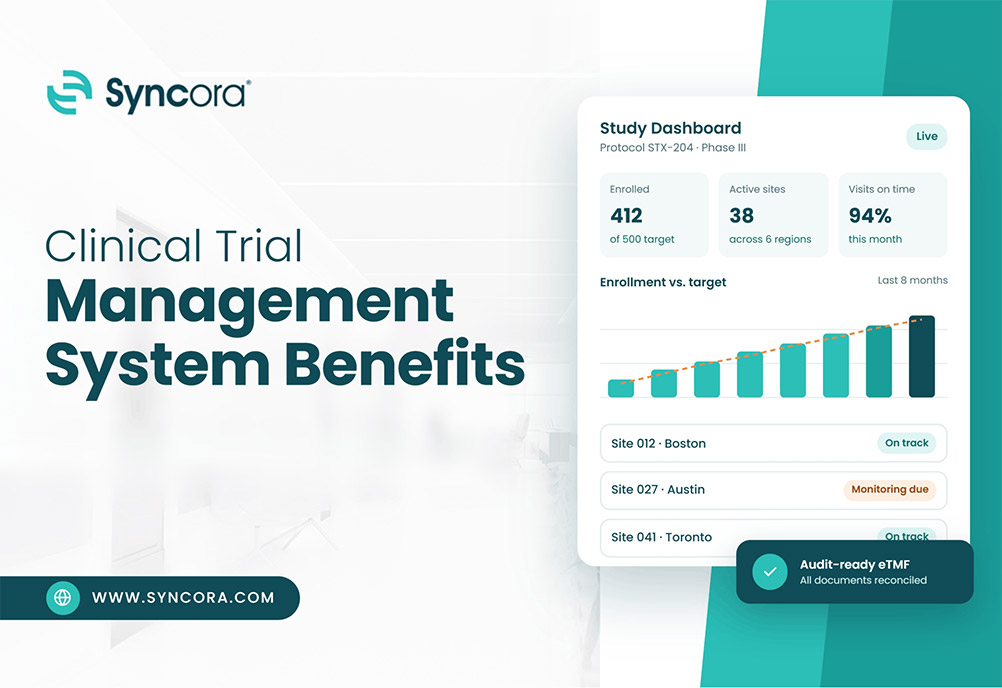
The main clinical trial management system benefits for small biotechs are centralized study information, better task visibility, easier site coordination, structured milestone tracking, and support for managing external partners.
A CTMS does not replace clinical operations expertise or sponsor oversight. Instead, it can provide a shared operational framework for teams that may otherwise rely on spreadsheets, email, shared folders, and separate tracking tools.
Key Takeaways:
- Small biotechs can have a lean internal team while managing a broad operational network.
- Clinical operations workload can increase quickly as studies add sites, vendors, regions, and activities.
- CTMS technology can centralize study information and make operational status easier to monitor.
- Startup task automation can reduce some repetitive tracking and administrative activities.
- A CTMS can support, but does not replace, CRO oversight for small sponsors.
- The value of a CTMS depends more on study complexity than on company headcount.
- Technology selection should consider the sponsor’s operating model, outsourcing strategy, workflows, and future needs.
Why Clinical Trial Operations Are Becoming More Complex
Understanding how small biotechs run clinical trials starts with recognizing that company size does not necessarily determine study complexity.
A biotech may have a relatively small internal clinical team while working with CROs, investigators, laboratories, technology providers, consultants, and other vendors. Each external relationship introduces activities that need to be coordinated.
For a clinical operations team, this can create a growing list of responsibilities:
- Study startup activities
- Site selection and activation
- Essential document tracking
- Vendor coordination
- Milestone monitoring
- Site communications
- Enrollment-related tracking
- Issue escalation
- CRO management
- Internal reporting
This is why clinical operations workload can grow faster than headcounts.
A small team may not need hundreds of employees to operate a complex trial. But it still needs a way to understand what is happening across the study.
That distinction is important when evaluating technology.
The Difference Between Team Size and Operational Complexity
A five-person clinical team managing one straightforward study is not operating under the same conditions as a five-person team managing several studies across multiple countries.
The second team may have more sites, vendors, milestones, dependencies, and reporting requirements despite having the same number of employees.
This is increasingly relevant to emerging biotech clinical trials, where companies may move from early development into larger and more distributed study programs.
The practical question becomes:
How much operational complexity can the existing team manage before its systems become a constraint?
A CTMS may be part of the answer, but it should be evaluated alongside processes, staffing, outsourcing, and governance.
1. Centralized Study Visibility
One of the most practical clinical trial management system benefits is having study information organized in a centralized environment.
Instead of maintaining separate spreadsheets for sites, milestones, tasks, and study activities, teams can use a CTMS to organize operational information in one system.
NIH’s BRICS platform, for example, describes CTMS functionality that supports clinical trial planning and execution, reporting, study documentation, correspondence, compliance-related information, and milestones.
For a small sponsor, centralized visibility can make it easier to answer basic operational questions:
- Which activities are complete?
- What is still outstanding?
- Which sites require follow-up?
- Which milestones are approaching?
- Who owns a particular task?
- Where are delays occurring?
The benefit is not that the system makes decisions for the team. The benefit is that the team has a more structured information base from which to make decisions.
2. Managing Clinical Operations Workload
The clinical operations workload associated with a study is rarely limited to one major activity.
This can include updating trackers, requesting status updates, checking task completion, preparing reports, and reconciling information from different sources.
One of the key CTMS benefits is the ability to bring many of these activities into a standardized workflow.
That does not mean every activity should be automated.
Clinical research still depends on qualified people, appropriate oversight, communication, and judgment. Technology can instead be used to reduce unnecessary duplication and make routine information easier to access.
The FDA has emphasized that computerized systems used in clinical trials should be appropriately documented, controlled, and maintained, with considerations including validation, change control, security, backup, and record integrity.
3. Making Study Startup Easier to Track
Study startups can create a particularly high study startup workload because multiple activities may need to progress in parallel.
Depending on the study and jurisdiction, teams may need to coordinate activities involving sites, contracts, regulatory submissions, essential documents, training, vendors, and activation requirements.
The challenge is not simply completing these activities. It is knowing their status and understanding how one outstanding item may affect another.
This is where startup task automation can be useful.
A CTMS may allow teams to establish task structures, assign ownership, monitor status, and create visibility into outstanding activities.
The value is especially relevant when the sponsor is coordinating multiple sites simultaneously.
Rather than asking several people for individual updates, the team can use a shared operational view to determine which activities require attention.
4. Supporting Multi-Site Coordination
As studies expand, multi-site coordination can become increasingly difficult.
Different sites may move through startup activities at different speeds. One site may be ready for activation while another is waiting for outstanding documentation or another operational dependency.
Without a centralized tracking approach, teams may have to consolidate information from multiple spreadsheets, emails, and vendor reports.
A CTMS can provide a structured way to monitor site-level activities and study milestones.
This is another important area where CTMS benefits can become more visible.
The system does not eliminate the need for site communication. Instead, it can give teams a clearer operational picture before they engage with sites or partners.
That can make conversations more focused because teams can discuss specific outstanding items rather than spending the entire conversation establishing basic status.
5. Supporting CRO Oversight for Small Sponsors
Many small biotechs rely on CROs because maintaining every clinical function internally may not be practical. This makes CRO oversight for small sponsors an important part of the operating model.
Outsourcing activities does not mean the sponsor stops needing visibility into study progress. Sponsors still need to understand timelines, responsibilities, milestones, issues, and deliverables relevant to their delegated activities.
FDA guidance recognizes that sponsors may delegate certain trial management responsibilities to other entities, including CROs, while maintaining sponsor responsibilities appropriate to the activity and study.
A CTMS can support this relationship by giving sponsor teams a structured view of operational information.
For example, instead of relying solely on periodic reports, a sponsor may use centralized study information to identify:
- Outstanding activities
- Site-level progress
- Upcoming milestones
- Delayed tasks
- Items requiring escalation
- Areas requiring additional discussion with the CRO
The technology is therefore not a substitute for CRO oversight for small sponsors. It can provide an operational framework that makes that oversight easier to organize.
6. Helping Lean Teams Work with Distributed Partners
A virtual biotech operating model often depends on external partners for specialized functions.
This model can offer flexibility, but it also creates a coordination requirement.
When clinical operations, regulatory, data management, laboratories, monitoring, and other functions are distributed across different organizations, information needs to be moved between those groups.
This is one reason how small biotechs run clinical trials cannot be reduced to an internal headcount question.
The more distributed the operating model becomes, the more important it is to establish clear ownership and information flows.
A CTMS can support that structure by providing a shared operational environment, depending on the platform’s functionality and how the sponsor configures it.
7. Reducing Reliance on Disconnected Trackers
Spreadsheets can be useful, especially for early-stage teams. The problem arises when a sponsor starts using multiple spreadsheets for overlapping activities.
One tracker may contain site information. Another may contain milestones. A third may track startup activities. A fourth may be used for CRO reporting.
Eventually, the team may have to spend time determining which tracker contains the most current information.
This can contribute to the clinical operations workload without directly advancing the study.
A CTMS can provide a structured environment for study-level information rather than requiring teams to build and maintain a growing collection of disconnected files.
8. Creating More Consistent Workflows
Consistency becomes increasingly important as a biotech adds studies, sites, and partners.
A standardized workflow can help teams define:
- What needs to happen
- Who owns each activity
- What information needs to be recorded
- When an activity is considered complete
- Which milestones require attention
- When an issue should be escalated
This can be especially useful for emerging biotech clinical trials, where processes may still be developed alongside the organization.
A CTMS can provide a framework for those workflows, although the quality of the result depends on how well the system is configured and used.
The technology should support the operating model rather than force the team into workflows that do not fit the study.
9. When Does a Small Biotech Actually Need a CTMS?
There is no universal employee count at which a company “need” a CTMS. The better question is whether the current operating model is becoming difficult to manage.
Signs that a sponsor may benefit from evaluating a CTMS include:
- Multiple active studies
- Increasing site numbers
- Several external vendors
- Significant clinical operations workload
- Growing study startup activity
- Frequent manual status reporting
- Difficulty maintaining a single source of operational information
- Increasing multi-site coordination requirements
- Greater need for structured CRO oversight
- Plans to expand the clinical development pipeline
The CTMS benefits may be less important for a very small study with limited operational complexity and more important as the number of moving parts increases.
CTMS vs. Adding More Clinical Operations Headcount
When workloads increase, companies often consider adding people. That can be the right decision.
But additional clinical operations headcount is not necessarily the answer to every operational problem.
Before adding another person to maintain trackers or compile repetitive reports, sponsors can ask whether the underlying workflow can be improved. For example:
- Is the problem a lack of people, or is the team spending too much time searching for information?
- Is the workload genuinely increasing, or are manual processes creating unnecessary work?
- Could standardized workflows remove repetitive administrative steps?
These questions help separate a staffing challenge from a process or technology challenge.
A CTMS should therefore be considered as part of a broader operating-model discussion, rather than as an alternative to experienced clinical professionals.
How CTMS Fits into Clinical Trial Outsourcing Decisions
Technology should also be considered when making clinical trial outsourcing decisions.
A sponsor may outsource most study execution to a CRO, maintain a hybrid model, or keep more functions internally. Each approach creates different information and oversight requirements.
For example, a sponsor using a highly outsourced model may need strong visibility across external partners. A sponsor with a larger internal operations team may have different technology requirements.
The important question is not:
“Should we outsource?”
It is:
“Which responsibilities should remain internal, which should be delegated, and how will we maintain appropriate oversight across both?”
Technology can support that model by organizing information and workflows, but it does not determine the appropriate allocation of responsibilities.
What to Look for in a CTMS?
For a small biotech evaluating a CTMS, functionality should be assessed against actual operational needs.
Key areas to consider include:
Study and Site Tracking: Can the system provide a clear view of study and site activities?
Task and Milestone Management: Can teams assign, track, and report on operational tasks and milestones?
Reporting: Can users generate the reports they actually need without excessive manual work?
Integration: Can the CTMS work appropriately with the sponsor’s existing technology environment?
Access and Controls: Does the system provide appropriate user access, security, auditability, and documentation features for its intended use?
FDA guidance on computerized systems used in clinical trials highlights the importance of system documentation, validation, change control, security, audit trails, backup, and recovery where applicable.
Scalability: Can the system support the sponsor if the number of studies, sites, or external partners increases?
The objective should not be to purchase the most sophisticated platform available. It should be to select a system that matches the organization’s actual requirements.
The Bigger Picture for Emerging Biotech Clinical Trials
The operational model for emerging biotech clinical trials is continuing to evolve. Smaller organizations can work with global CROs, distributed research sites, technology vendors, and specialized partners without building every capability internally.
That flexibility can create opportunities, but it also increases the importance of clear operational coordination. The clinical trial management system benefits are therefore best understood in this broader context.
A CTMS is not simply a database or a replacement for spreadsheets. When appropriately selected and implemented, it can become part of the infrastructure supporting study operations.
For small sponsors, the goal should be straightforward:
Give the team the visibility, structure, and workflows needed to manage the trial without creating unnecessary administrative complexity.
Conclusion
The most relevant clinical trial management system benefits for small biotechs are not about having more technology for its own sake. They are about creating better structures around increasingly complex clinical operations.
A CTMS can help centralize information, organize tasks, support multi-site coordination, provide visibility into study startups, and strengthen the operational framework used for CRO oversight for small sponsors.
At the same time, technology should not be treated as a replacement for clinical expertise or sponsor responsibility. The right solution depends on the organization’s study portfolio, workflows, partners, internal capabilities, and clinical trial outsourcing decisions.
Frequently Asked Questions
What are the main CTMS benefits for small biotechs?
The main CTMS benefits include centralized study information, task tracking, milestone visibility, site coordination, reporting support, and a more structured approach to managing operational activities.
How can a CTMS help with clinical operations workload?
A CTMS can organize study information and repetitive operational activities in one environment. Depending on the platform, it may also support task automation, reporting, milestone tracking, and standardized workflows.
How do small biotechs run clinical trials with lean teams?
Many small biotechs use a combination of internal clinical expertise and external CROs or specialized vendors. Their operating models can vary considerably depending on the study, development stage, resources, and outsourcing strategy.
Does every small biotech need a CTMS?
Company size alone should not determine the decision. Study complexity, site numbers, vendor relationships, internal processes, reporting requirements, and expected growth are more useful considerations.
How does a CTMS support CRO oversight for small sponsors?
A CTMS can give sponsor teams a structured view of tasks, milestones, site activities, and other operational information. This can support conversations with CRO partners and help sponsors organize their oversight activities.
Can a CTMS replace clinical operations headcount?
A CTMS is a technology tool, not a substitute for clinical operations expertise. It can help organize workflows and reduce some manual administrative work, but clinical judgment, oversight, and decision-making still require appropriately qualified professionals.


