

Quick Answer:
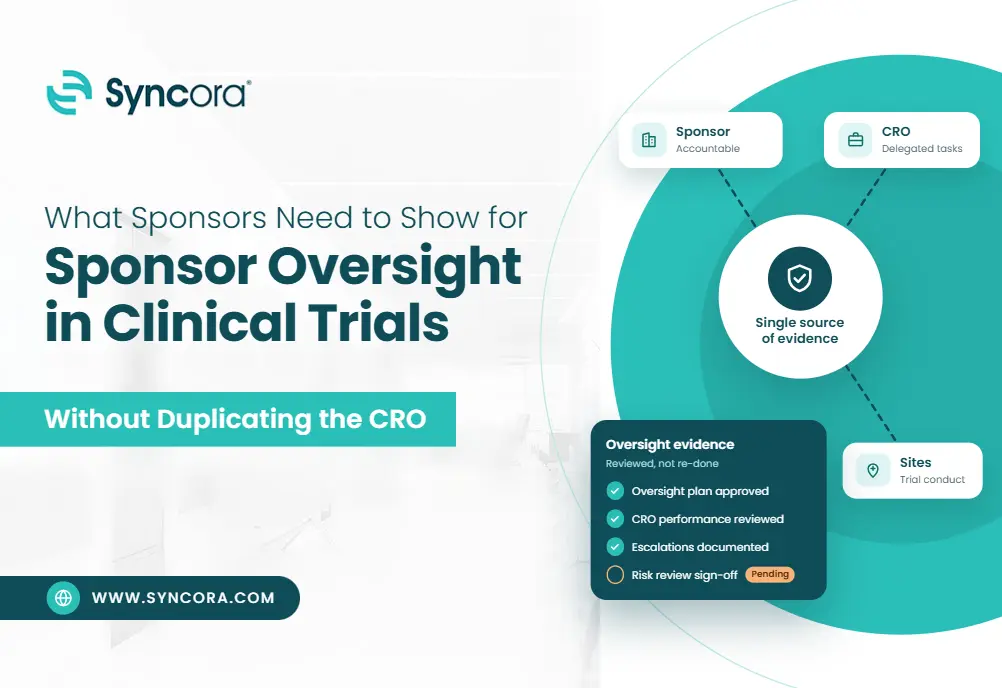
When a sponsor works with a contract research organization (CRO), it can be tempting to assume that the CRO’s detailed operational records are enough to demonstrate oversight. But effective sponsor oversight in clinical trials is not about repeating every activity performed by the CRO. It is showing that the sponsor has established appropriate responsibilities, understands how delegated activities are being managed, reviews meaningful information, and acts when risks or issues require attention.
What Does Sponsor Oversight Actually Mean?
Sponsor oversight in clinical trials is the sponsor’s process for maintaining visibility and control over trial activities that may be performed by internal teams, CROs, vendors, sites, or other service providers.
The sponsor does not necessarily need to perform the CRO’s work again. Instead, the sponsor should be able to demonstrate that appropriate decisions were made about:
- Which activities were delegated
- Who is responsible for each activity
- How the CRO will perform and report those activities
- Which risks and performance indicators require sponsor attention
- How important issues are escalated and resolved
- What information the sponsor reviews throughout the study
ICH E6(R3) specifically states that agreements should document transferred activities and that sponsors should have access to relevant information for selecting and overseeing service providers.
This creates an important distinction: CRO oversight and sponsor oversight are connected, but they are not interchangeable.
Sponsor vs. CRO: Where Should the Line Be?
A CRO may manage day-to-day clinical trial operations, while the sponsor maintains strategic oversight of those activities.
For example, a CRO may coordinate site monitoring, maintain project trackers, manage study timelines, prepare reports, and escalate operational risks. The sponsor does not necessarily need to recreate those trackers or independently repeat every operational check.
Instead, the sponsor may review appropriate performance information, assess significant risks, challenge unexpected trends, document decisions, and confirm that corrective actions are followed through.
The exact allocation depends on the study, agreement, applicable requirements, and risk profile. ICH E6(R3) requires sponsors to determine and document the allocation of trial-related activities before clinical trial activities begin.
For sponsors, the goal should be visibility without unnecessary duplication.
What Should Sponsor Oversight Documentation Show?
Strong sponsor oversight documentation should tell a clear story. An auditor or inspector should be able to understand:
1. What was delegated?
The sponsor should have a documented understanding of which activities were transferred to the CRO or another service provider.
2. Who owns the responsibility?
Documentation should distinguish between activities performed by the CRO and responsibilities retained by the sponsor.
3. How is performance being evaluated?
Sponsors should identify the information they use to understand whether important activities are progressing as expected.
4. How are risks escalated?
Significant issues should have a documented pathway for escalation, review, decision-making, and follow-up.
5. What decisions did the sponsor make?
Meeting minutes, issue logs, decision records, review notes, action trackers, and other appropriate records can help demonstrate active oversight.
ICH E6(R3) notes that sponsors should have access to relevant information such as standard operating procedures and performance metrics when selecting and overseeing service providers.
The evidence does not need to be excessive. It needs to be relevant, traceable, and proportionate to the trial.
What Evidence Can Sponsors Maintain?
There is no single universal file that proves oversight. Instead, oversight evidence clinical research teams maintain can come from several connected sources.
Depending on the study and delegated responsibilities, useful evidence may include:
1. Delegation and responsibility matrices
A responsibility matrix can show who performs, reviews, approves, or escalates key trial activities.
This helps prevent uncertainty when responsibilities are divided between sponsor personnel, CRO teams, vendors, and sites.
2. CRO performance reviews
Sponsors can retain evidence of periodic reviews covering agreed milestones, risks, quality indicators, enrollment activity, monitoring performance, issue resolution, or other study-specific measures.
3. Governance meeting records
Steering meetings, sponsor-CRO governance meetings, escalation calls, and study reviews can demonstrate that the sponsor receives information and makes decisions based on it.
4. Issue and escalation records
A documented issue tracker can help demonstrate how significant problems were identified, assessed, assigned, escalated, and closed.
5. Risk review records
Risk assessments and periodic reviews can show that oversight activities are focused on areas that matter most to the trial rather than treating every activity identically.
FDA’s current E6(R3) guidance emphasizes risk-proportionate approaches, quality by design, and focusing attention on factors critical to trial quality.
Does a Sponsor Need a Separate CRO Management Plan?
A CRO management plan can be useful when it clearly defines how the sponsor will oversee the CRO’s work.
It should not simply reproduce the CRO’s project management plan. Instead, the sponsor-focused document can describe areas such as:
- Governance structure
- Roles and responsibilities
- Communication frequency
- Key performance indicators
- Risk and issue escalation
- Decision-making authority
- Quality oversight
- Vendor and subcontractor oversight
- Meeting cadence
- Reporting expectations
- Documentation and record retention
- Processes for addressing underperformance
The level of detail should be appropriate for the trial. A simple study may not require the same governance structure as a complex, multinational trial involving multiple CROs and vendors.
The important question is not, “Do we have more documents?”
It is, “Can we demonstrate that the sponsor knows what was delegated, receives meaningful information, evaluates important risks, and takes appropriate action?”
What Sponsors Should Avoid?
Oversight can become inefficient when sponsors try to duplicate the CRO’s operational work.
For example, a sponsor may already receive detailed monitoring reports from a CRO. Creating a second sponsor-level monitoring report that repeats every operational detail may add documentation without adding meaningful oversight.
Similarly, sponsors do not necessarily need to independently recreate every site tracker, query log, or project management dashboard.
Instead, sponsor review should focus on information that supports meaningful oversight and decision-making.
A practical approach is to define a sponsor oversight in clinical trials framework around critical activities and risks. For example:
| CRO Activity | Sponsor Oversight Focus |
|---|---|
| Site monitoring | Significant findings, trends, unresolved issues, escalation |
| Enrollment management | Progress against expectations, risks, corrective actions |
| Data management | Important data-quality trends and unresolved concerns |
| Safety activities | Appropriate reporting, escalation, and sponsor review |
| Regulatory activities | Critical submissions, approvals, commitments, and issues |
| Vendor management | Performance, risks, major issues, and escalation |
| Study timelines | Milestones, delays, root causes, and recovery plans |
The sponsor is therefore reviewing the meaning and impact of the CRO’s work rather than simply repeating it.
How Technology Can Support Sponsor Oversight?
Technology can make oversight more visible without creating another layer of manual administration.
Dashboards, centralized trackers, electronic trial systems, and structured reporting can help sponsors monitor study milestones, risks, performance indicators, and outstanding actions.
The technology itself, however, is not the evidence of oversight. What matters is how the information is used.
For example, a dashboard showing a recurring site-level issue becomes more meaningful when there is evidence that the sponsor reviewed the trend, discussed it with the CRO, determined whether escalation was necessary, and followed the resulting action. Platforms like Syncora give sponsors that visibility in one place without adding a manual reporting layer
Building Oversight Around Risk, Not Volume
The strongest oversight model is not necessarily the one with the largest number of documents.
It is the one that focuses attention where the consequences of failure could be most significant.
FDA’s E6(R3) guidance describes a risk-proportionate approach to trial conduct and oversight, while ICH E6(R3) states that sponsors should ensure appropriate oversight of important activities transferred to service providers.
That means sponsors can prioritize oversight around critical-to-quality factors, significant risks, important milestones, emerging trends, and unresolved issues.
For example, if a study is experiencing enrollment challenges at several sites, sponsor oversight might focus on the CRO’s recruitment strategy, site performance trends, root-cause analysis, and corrective actions.
If the study has recurring monitoring findings, the sponsor may focus on the pattern, severity, escalation, and effectiveness of remediation rather than recreating every monitoring activity.
This approach makes oversight more strategic and less duplicative.
Sponsor Responsibilities Still Matter After Delegation
Delegating work to a CRO does not mean the sponsor stops being responsible for the activities it has retained.
Under ICH E6(R3), sponsors can transfer some or all trial-related activities to service providers, but ultimate responsibility for the sponsor’s trial-related activities remains with the sponsor. Sponsors are also responsible for assessing the suitability of service providers and maintaining appropriate oversight of important, transferred activities.
This is why sponsor responsibilities clinical trials should be clearly defined from the beginning.
The sponsor should understand what the CRO is expected to deliver, what information will be provided back to the sponsor, which decisions remain with the sponsor, and how significant concerns will be escalated.
A clear operating model can reduce both gaps and unnecessary duplication.
Final Thoughts
Effective sponsor oversight in clinical trials is about maintaining accountability and visibility, not performing the CRO’s work twice. A sponsor can rely on a CRO for operational execution while still maintaining a clear understanding of delegated responsibilities, performance, risks, issues, and important decisions.
The strongest approach is to establish the oversight model early, define responsibilities clearly, identify the information that matters, and maintain evidence showing how that information was reviewed and acted upon.
When sponsor and CRO responsibilities are structured properly, oversight becomes a governance function rather than a duplicate operational layer. The result is a clearer record of accountability, more focused decision-making, and an oversight process that can scale with the complexity of the study.
Frequently Asked Questions
What is sponsor oversight in clinical trials?
Sponsor oversight in clinical trials means monitoring delegated trial activities, reviewing risks and performance, and making appropriate decisions.
Does a sponsor need to repeat the CRO’s monitoring activities?
Sponsors do not need to duplicate CRO activities but should maintain evidence of appropriate oversight and review.
What is included in sponsor oversight documentation?
It may include responsibility matrices, meeting records, risk reviews, performance reports, escalation logs, and sponsor decisions.
What is the purpose of a CRO management plan?
A CRO management plan defines responsibilities, communication, reporting, performance review, escalation, and governance between the sponsor and CRO.
What counts as oversight evidence clinical research teams can maintain?
Oversight evidence clinical research teams can maintain includes performance reviews, meeting records, risk assessments, escalation documentation, and action tracking.


