

Key Takeaways
- A CRM tracks sponsor and CRO contacts from first contact onward, across every study.
- A CTMS stops updating at closeout, and pre-award work leaves no record at all.
- With 57% of protocols amended at least once (Tufts CSDD, 2016), log who agreed to each change.
- Record enrollment, screen-fail rate, and query turnaround after closeout for your next feasibility pitch.
Quick Answer:
Research sites need a CRM because sponsors award studies based on relationships and track record, and a CTMS ties contacts to single protocols. With 11% of sites enrolling no patients and 37% under-enrolling (Tufts CSDD), sponsors favor known sites. A CRM keeps sponsor and CRO history across studies, including after closeout.
Introduction
Your site ran two studies for a sponsor, hit enrollment on both, and closed out clean. Then their next Phase III went to the site across town. Ask who last spoke to that sponsor’s clinical ops lead, and the room goes quiet. That silence usually isn’t anyone’s fault.
Your clinical trial management system exists to run protocols, and it handles visits, monitoring, and payments well. But sponsor and CRO relationships outlive every protocol you sign.
Below, we’ll cover how sponsors actually pick sites, what your trial system tracks (and quietly drops), where relationship history leaks out, and how two systems split the work.
Why do sponsors keep returning to the same handful of sites?
A known site is a lower-risk site, and sponsors have the enrollment data to show why that matters to them. Sponsors would rather back a horse they’ve already watched run.
The enrollment numbers behind every site-selection call
Nearly half of sites fall short on enrollment. A Tufts CSDD Impact Report found that 11% of sites in a multi-site trial failed to enroll a single patient, and another 37% under-enrolled.
Each of those sites still cost the sponsor startup fees, an SIV, and monitoring time. Your enrollment history follows you into every feasibility round, good or bad.
The relationship lives in people, and people change jobs
Site selection runs on individuals, and individuals switch jobs constantly. Say the CRO feasibility lead who loved your rare-disease recruitment moves to a sponsor. That’s a warm door into her new company (if anyone spots the LinkedIn update). Same with the hallway chat at an SCRS summit with a sponsor’s site-relations director. Great conversation, cards swapped, nothing written down.
Most sites solved study-side tracking years ago with a CTMS for clinical research. Who-knows-whom never made the jump. It still sits in personal inboxes, and inboxes leave when people do.
What does CTMS software actually track at a site?
This software tracks the operational side of each active study and files nearly every record under that study’s protocol number. At most sites, that covers five areas:
- Subjects: Who screened, who screen-failed, who randomized, and who withdrew. Accrual sits next to the enrollment target, so a lagging study shows up fast.
- Visit schedules and windows: Day 28, plus or minus three days, mapped for every subject. Miss the window, and you’ve got a protocol deviation to document.
- Monitoring visits: Dates for each interim monitoring visit, plus the action items from the CRA’s follow-up letter. Those items stay open until someone resolves them.
- Milestones: SIV, first patient in, last patient out, database lock, and closeout.
- Payments: Per-visit fees, invoiceable items like screen fails and unscheduled visits, and holdbacks the sponsor keeps until closeout. (Reconciling these eats whole afternoons.)
Because the system organizes everything around the protocol, the record stops changing after the closeout visit. Finance reconciles the final payment, the sponsor releases the holdback, and the study status moves to closed. None of those fields record who at the sponsor supported your site’s selection. They also can’t show whether that contact would bring your site its next study.
Can’t you just keep sponsor contacts in your CTMS?
You can, and most systems have a contacts table. The catch is what those contacts are attached to. Usually that’s a study, so the contact goes dormant at closeout.
Everything that happens before there’s a protocol number
Most of the work that wins a study happens before a protocol number exists. You sign a CDA to see the synopsis. You answer a feasibility questionnaire inside the CRO’s portal. Sometimes a PSV goes well, and then a polite email says the sponsor picked other sites.
Then there’s the study you turned down (sites forget these fastest). Maybe it competed with another trial for the same patients. Maybe the comparator arm clashed with your standard of care, or the budget couldn’t cover a screening-heavy protocol. None of that has a study record to sit on. Two years later, the same lopsided budget arrives, and nobody remembers why you said no.
When the CRA changes for the third time
CRA turnover is routine, and your trial system handles it by swapping one name for another. The new monitor inherits the open action items. They don’t inherit the context: which PI prefers Thursday visits, how the last CRA wanted source notes filed. It’s a familiar scene at busy sites: a sticky note on a coordinator’s screen listing each study’s CRA. By month ten, she’s crossed out three names.
The bigger miss sits upstream. Your CRA rarely decides your next award. The CRO’s feasibility team, the sponsor’s site-selection group, and their clinical ops lead do. Yet a trial system logs the monitor of record and stops there.
What does a CRM for clinical trials track that study software misses?
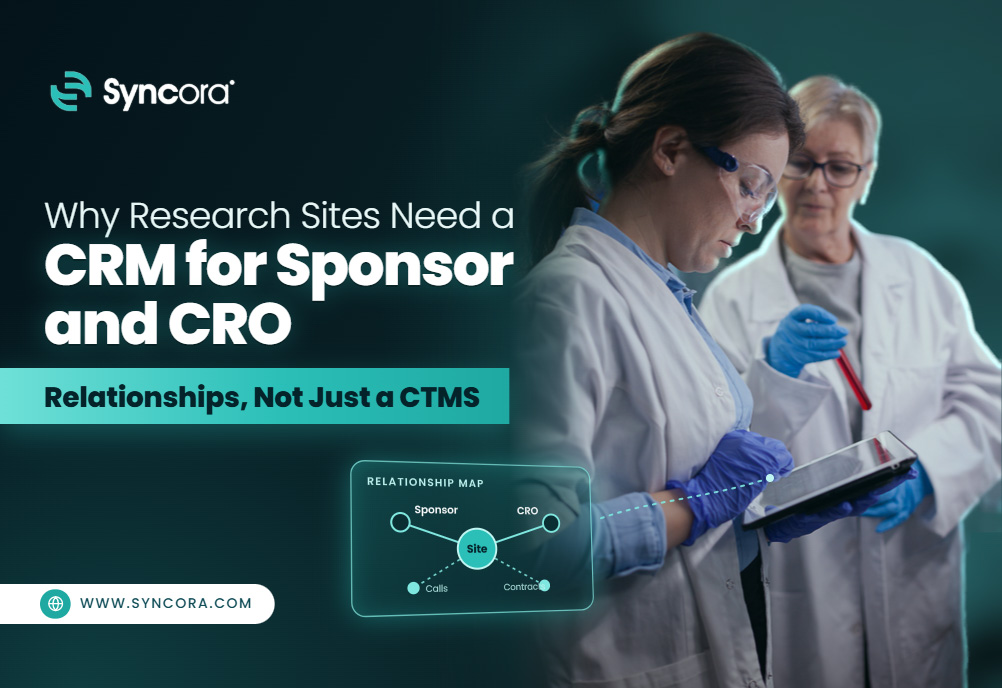
The people and companies behind every study, including the ones you never ran. A CRM is the memory nobody asked your trial system to keep. It works whether or not a protocol ever shows up. Here’s how clinical trial management software and a relationship CRM split the record:
The bigger shift is treating sponsors like a pipeline. Every sponsor and CRO sits at a stage, from first contact through active talks to preferred partner, and someone owns the next move. Stalls tell you something too.
Four feasibility questionnaires from one CRO and zero awards? That’s worth a call to their feasibility lead (politely, with your enrollment numbers in hand). Sites already run patient recruitment pipelines this way, so the habit isn’t new.
One study, two systems, and where the handoff happens
They aren’t rivals. They split the timeline. The CRM holds the relationship before, between, and after studies, while the trial system owns everything inside one.
Here’s how one study moves between them:
- Courtship: Calls, CDAs, and feasibility questionnaires live in the CRM, tied to the contacts who sent them.
- Award: The CTA and budget go back and forth with the CRO’s contracts team.
- Activation: After the SIV and sponsor greenlight, the live study runs in the clinical trial management system: subjects, visits, monitoring, payments.
- Mid-study changes: Amendments land, bringing re-consent, IRB resubmission, and often a budget conversation.
- Closeout: The debrief goes back into the sponsor record, where your next pitch will need it.
Step four happens more often than most budgets assume. Getz and colleagues at Tufts CSDD found that 57% of protocols had at least one substantial amendment. Each one can reopen budget and timeline talks. Your trial system logs the amendment. The CRM should log who agreed to what.
Coordinator tip:
Within two weeks of the closeout visit, add three figures to the sponsor’s record: patients enrolled against target, screen-fail rate, and your team’s average query resolution time. When that sponsor sends its next feasibility questionnaire, these figures give you concrete evidence of your site’s performance.
Who at your site should own sponsor and CRO relationships?
Ownership means someone decides when a sponsor moves stages and who makes the next call. Everyone else adds what they see from their seat.
- Site owner or director: Owns the pipeline and the stage calls. They decide which sponsors to chase and which feasibility requests deserve a polite pass.
- Coordinators: Log CRA changes, monitoring friction and sponsor portal quirks. Nobody sees the day-to-day side more clearly, down to which portal times out mid-upload.
- PIs: Own ties with the medical monitor and therapeutic-area KOLs. Notes from investigator meetings belong in the record too, since sponsor teams remember who asked sharp questions.
A shared view beats one person’s inbox, especially when that person goes on leave halfway through a feasibility round.
Where Syncora fits
That shared view has to live somewhere before any protocol number exists, and that’s the stretch Syncora covers as a pre-CTMS study-startup platform with a built-in CRM. Sponsor and CRO contacts sit next to the startup tasks they lead to, and they don’t go dormant at closeout. Once a study goes live, your clinical trial management system software takes over the visits, monitoring, and payments.
Frequently Asked Questions
What’s the difference between a CTMS and a CRM?
A CTMS runs individual studies, while a CRM manages the sponsors and CROs behind them. The CTMS organizes records around the protocol and stops changing at closeout. A CRM organizes records around companies and contacts, starting at first contact and staying open across every study.
Can a CTMS manage sponsor relationships?
Only partly. Most CTMS platforms have a contacts table, but each contact sits inside a study and goes inactive at closeout. Work that happens before a protocol exists, such as CDAs, feasibility questionnaires, and declined studies, has no study record to attach to.
Who should manage sponsor relationships at a research site?
The site director or site owner should manage them, deciding when each sponsor moves to the next stage.
Conclusion
Sponsors pick sites they trust, and that trust builds across studies, not inside one. Your clinical trial management system will keep every protocol in order. The relationships that bring those protocols to your door deserve the same care. That includes the feasibility lead who changed jobs and the study you declined two years ago. Sites that track both walk into feasibility rounds with context and a record they can point to. Everyone else starts from scratch every time.
If your sponsor history still lives in a few inboxes, talk to the Syncora team before the next questionnaire arrives.


