

Key Takeaways
- Create a centralized vendor directory to keep vendor contacts, services, agreements, and documentation in one place.
- Link each vendor to the specific studies and research sites they support to maintain clear visibility across trial operations.
- Document vendor responsibilities, service scopes, deliverables, and communication procedures for each assignment.
- Keep vendor records updated whenever providers are added, replaced, or removed from a study or site.
- Review vendor performance through service timelines, deliverables, and regular oversight activities.
- Use clinical trial management software to organize vendor assignments, track changes, and improve visibility across multiple studies and sites.
Quick Answer:
Effective vendor management in clinical trials helps research teams maintain visibility into these relationships. It allows sponsors, CROs, and research sites to identify which vendors are assigned to each study, understand the services they provide, and monitor their responsibilities throughout the trial. A structured vendor tracking system, supported by clinical trial management software, can make these relationships easier to organize, update, and review.
Why Is Vendor Tracking Important in Clinical Trials?
Clinical research involves multiple operational activities that may require support from external service providers. These vendors help sites and sponsors manage specialized tasks, resources, and services throughout a study.
However, knowing which vendors an organization works with is only part of the process. Research teams also need to know where each vendor is assigned, and which studies depend on its services.
For example, a clinical research organization may work with three laboratory providers across ten research sites. Some sites may use one laboratory for sample processing, while others may work with a different provider based on location, study requirements, or available services.
If this information is not organized, teams may experience several challenges:
- Limited visibility: Teams may not know which vendors are supporting individual sites or studies.
- Duplicate vendor records: The same provider may appear under different names or contact records across departments.
- Communication gaps: Site coordinators and study managers may struggle to identify the correct vendor contact.
- Service disruptions: Changes in vendor assignments may not reach everyone who needs the information.
- Difficult reporting: Teams may spend additional time gathering information about vendor assignments and service coverage.
A reliable clinical trial vendor management process creates a clear record of these relationships. It also supports vendor oversight by making it easier to identify responsibilities, review service performance, and maintain relevant documentation.
What Types of Vendors Are Involved in Clinical Trials?
Before building a vendor tracking process, it helps to understand the different service providers involved in clinical research.
The types of vendors in clinical trials vary depending on the study design, therapeutic area, geographic location, and operational requirements.
Common examples include:
1. Central and Local Laboratories
Laboratories perform services such as sample processing, testing, and analysis. A study may use a central laboratory for standardized testing across multiple sites or local laboratories for specific regional requirements.
2. Imaging Providers
Imaging vendors support studies that require specialized diagnostic imaging, including MRI, CT scans, X-rays, and other imaging assessments. Their involvement may be limited to sites or specific study protocols.
3. Patient Recruitment Vendors
These providers help research teams identify and reach potential participants through recruitment campaigns, referral networks, and other outreach activities.
4. Logistics and Courier Providers
Clinical trials may require specialized transportation for biological samples, investigational products, laboratory materials, and other study-related supplies. Logistics vendors help coordinate these movements.
5. Technology and Software Providers
Technology vendors supply systems used for trial operations and data management. These may include electronic data capture (EDC), clinical trial management systems (CTMS), electronic trial master files (eTMF), and randomization systems.
6. Specialized Clinical Service Providers
Depending on the study, additional vendors may provide translation, medical imaging reviews, safety reporting, data management, biostatistics, or other specialized services.
Each vendor may support different sites, studies, or operational requirements. Maintaining accurate records of these assignments is essential for effective coordination.
How to Keep Track of Which Vendors Support Each Site and Study
A consistent tracking process makes it easier to understand vendor relationships across an entire research organization. The following steps can help create a more organized approach.
1. Create a Centralized Vendor Directory
Start by building a master directory of all vendors working with your organization.
Instead of maintaining separate contact lists for individual studies or departments, keep vendor information in one centralized location. This gives authorized team members a consistent source of information.
Each vendor profile should include:
- Vendor or company name
- Primary contact person
- Contact details
- Services provided
- Geographic coverage
- Contract or agreement status
- Service starts and end dates
- Relevant qualification and compliance documentation
A centralized directory also helps teams identify existing providers before engaging new ones. This can reduce duplicate records and make vendor information easier to maintain.
2. Link Vendors to Specific Studies
A vendor directory alone does not show which studies depend on each provider.
For this reason, every vendor assignment should be connected to the relevant study. Record the study name or identification number, protocol reference, vendor, assigned service, and assignment dates.
For example, a laboratory may support Study A for sample processing but are not involved in Study B. Similarly, an imaging provider may be assigned to only one study within a larger research portfolio.
Keeping these relationships study-specific helps project managers understand, which services are available for each protocol and identify changes when a vendor is added, replaced, or removed.
3. Connect Vendor Assignments to Individual Sites
The next step is to identify which sites each vendor supports within a study.
A vendor may support every participating site, only selected locations, or a specific group of sites within a particular region.
For example:
- Study A uses Lab X at Sites 001, 002, and 003.
- Study B uses Lab Y at Sites 001 and 004.
- Study C uses Imaging Provider Z at Sites 002 and 005.
This information creates a clearer picture of vendor coverage at the site level.
It also helps site coordinators quickly identify which service providers they should contact for study-related activities.
4. Document Vendor Responsibilities and Service Scope
Knowing a vendor’s name is not enough. Teams also need to understand exactly what the vendor is responsible for.
Maintain a record of the services included in each assignment, along with the relevant scope of work and responsibilities.
For instance, if a central laboratory supports a study, document whether its responsibilities include sample collection kits, sample processing, testing, storage, or transportation coordination.
Also record:
- Assigned responsibilities and deliverables
- Primary and backup contacts
- Service-level expectations
- Communication and escalation procedures
- Applicable agreements and quality requirements
- Reporting and performance review schedules
Clearly documented responsibilities help prevent misunderstandings between sponsors, CROs, vendors, and research sites.
5. Maintain Up-to-Date Vendor Assignment Records
Vendor relationships can change throughout a clinical trial. A provider may be replaced, a site may begin using an additional service, or a study may require a different operational arrangement.
These changes should be reflected in the central tracking system as they occur.
Establish a process for recording new assignments, updating existing relationships, and closing inactive vendor links.
It is also useful to maintain a change history that identifies who made an update, when it was made, and what changed. This creates a more reliable record for internal reviews and operational follow-up.
6. Review Vendor Performance and Oversight Requirements
Vendor tracking should go beyond maintaining contact information. Research teams also need a process for monitoring whether vendors are fulfilling their assigned responsibilities.
Establish performance indicators based on the services being provided. These may include:
- Turnaround times for laboratory results
- Sample handling and processing issues
- Imaging submission timelines
- Recruitment progress against agreed targets
- Delivery timelines for study supplies
- Outstanding service-related issues
The level of oversight should reflect the nature and importance of the delegated activities.
The ICH E6(R3) Good Clinical Practice guideline emphasizes appropriate sponsor oversight of trial-related activities transferred to service providers. It also highlights the importance of access to relevant information for vendor selection and oversight.
A documented review process helps teams identify service concerns and determine when corrective action or additional oversight may be needed.
How Clinical Trial Management Software Helps Organize Vendors?
Maintaining vendor information across spreadsheets and separate documents may work for a small number of studies. However, as an organization expands its research operations, managing these relationships manually becomes more difficult.
This is where clinical trial management software can help.
A clinical trial management system (CTMS) provides a centralized platform for organizing and tracking trial operations. Depending on the system and its configuration, it may support study and site management, milestone tracking, monitoring activities, financial records, and vendor information.
When evaluating CTMS software, consider features that support the following activities:
Centralized Vendor Records
A centralized vendor database helps teams maintain consistent profiles, contact information, service categories, and relevant documentation.
Study and Site-Level Vendor Mapping
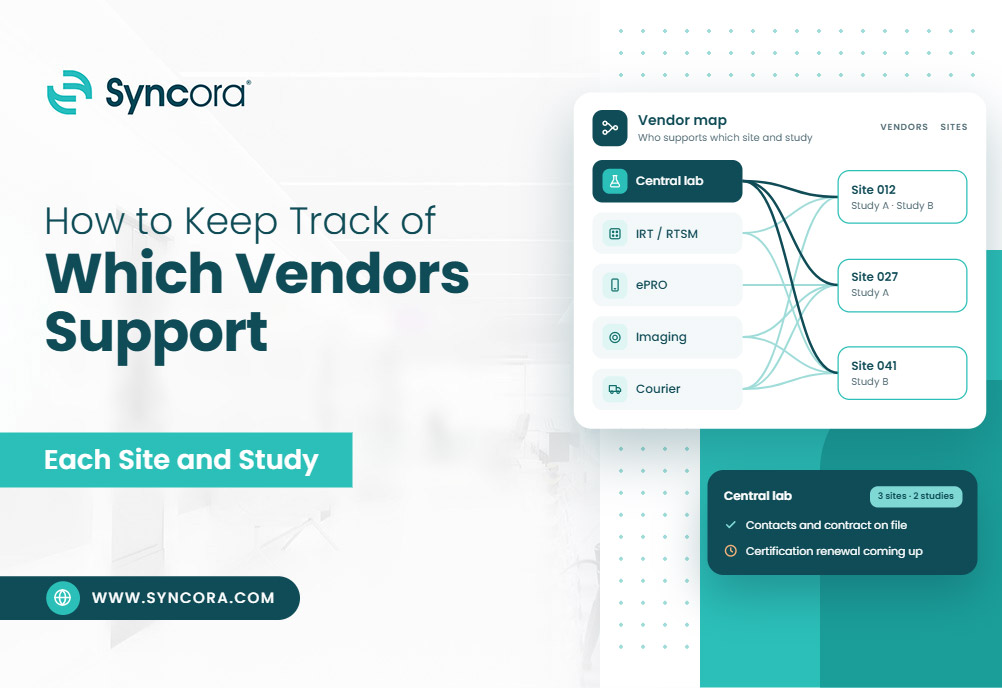
The system should make it possible to connect vendors to specific studies and participating sites. This allows users to identify which providers support a particular location or research project without searching through multiple files.
Assignment and Status Tracking
Teams should be able to review whether a vendor assignment is active, pending, completed, or no longer applicable. Tracking assignment dates and changes also helps maintain accurate operational records.
Reporting and Visibility
Reporting tools can help managers review vendor coverage across multiple studies and sites. They can also make it easier to identify locations without an assigned provider for a required service.
Document and Activity Tracking
Relevant agreements, service records, and oversight activities should be accessible to authorized users. Audit trails and change histories can further support accountability and record management.
Not every clinical trial software platform includes dedicated vendor-to-site and vendor-to-study mapping. Therefore, organizations should evaluate these capabilities during software selection rather than assuming they are standard features.
The right system should support the organization’s actual vendor management workflow, not simply provide another place to store contact information.
What to Look for When Choosing a Vendor Management System
Selecting the right system is an important part of improving vendor coordination. Before investing in clinical trial management software, consider the following questions:
- Can vendors be linked to multiple studies and sites? The system should support the relationships that exist within your research operations.
- Can vendor information be updated centrally? Changes should be reflected consistently without creating duplicate records.
- Does it maintain assignment history? Teams should be able to review previous and current vendor relationships.
- Can users access relevant information based on their roles? Site coordinators, study managers, and other team members may require different levels of access.
- Does it support reporting? Managers should be able to review vendor coverage and assignments without manually combining multiple spreadsheets.
- Can it integrate with existing systems? Consider how vendor information will work alongside your existing clinical research applications and workflows.
Effective vendor selection and management in clinical trials requires more than choosing a platform with a long list of features. The system should make vendor relationships easier to understand, maintain, and oversee throughout the study lifecycle.
Conclusion
Keeping track of which vendors support each site and study requires a structured approach to vendor information, assignment records, and ongoing oversight.
A centralized vendor directory, study-specific assignments, site-level mapping, documented responsibilities, and regular reviews can help research teams maintain better visibility across their operations.
As clinical research portfolios grow, clinical trial vendor management becomes increasingly difficult to handle through disconnected spreadsheets and manual updates. Using suitable CTMS software can bring important operational information into one place, helping teams understand vendor coverage and coordinate responsibilities more effectively.
Frequently Asked Questions
What is vendor management in clinical trials?
Vendor management in clinical trials is the process of selecting, qualifying, contracting, tracking, and overseeing external service providers involved in trial activities. It helps ensure that vendors understand their responsibilities and perform their assigned services according to applicable requirements and agreements.
What are the most common vendors in clinical trials?
Common clinical trial vendors include central laboratories, imaging providers, patient recruitment agencies, courier and logistics companies, EDC and CTMS providers, data management organizations, and specialized clinical service providers.
How can research teams track vendors across multiple sites?
Research teams can use a centralized vendor directory that connects each provider to specific studies and sites. Maintaining service details, assignment dates, contact information, and change histories helps teams keep these relationships accurate and accessible.


