

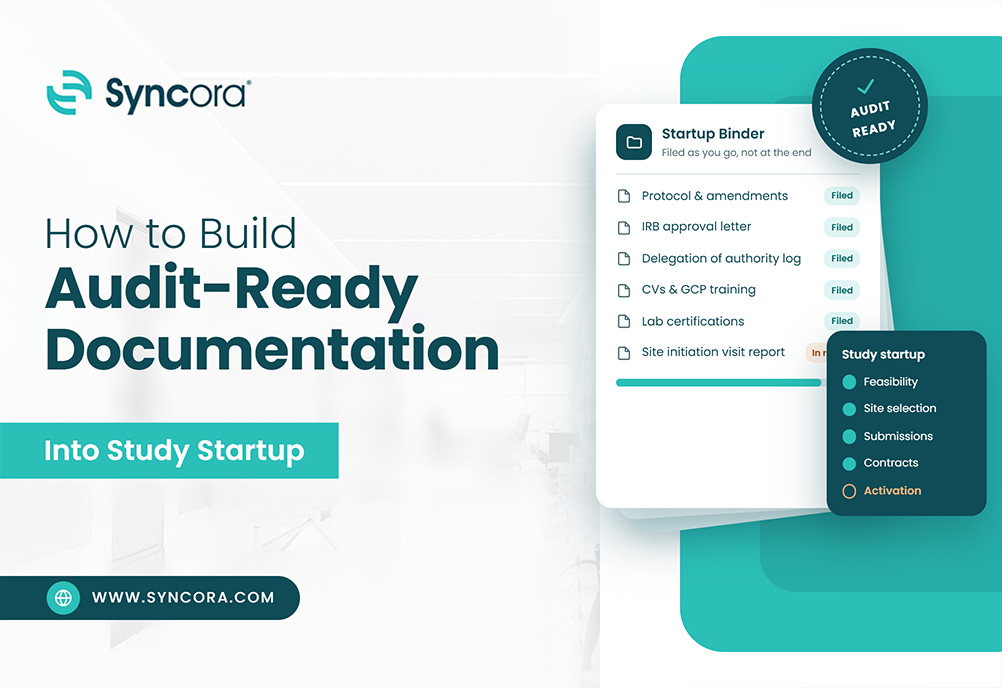
Key Takeaways
- Your audit ready documentation clinical trials plan should start on day one, not at closeout.
- Clinical trial documentation requirements start with signatures, dates, and staff qualifications.
- Most gaps come from scattered files and unclear ownership, not careless people.
- A fixed workflow with named owners prevents late fixes.
- One central platform keeps your trial files complete and visible to the whole team.
Quick Answer
To build audit-ready documentation into study startup, plan your records before the first site opens. Start by listing every required document for each site and country. Then name one owner and one due date for each item. Check every record for signatures, dates, and version numbers before filing it. Finally, track all files in one system and compare it against your plan each week. Doing this early matters most, because startup records shape every later inspection. This routine gives you audit ready documentation clinical trials inspectors can trust. It also protects TMF (trial master file) completeness and shows regulators that your team stays in control.
Introduction
An inspector asks for a signed CV from two years ago. Your team searches three inboxes and two shared drives. Nobody finds it.
Sadly, this scene is common. But, it is also avoidable. Most documentation problems begin during study startup, not at closeout. Therefore, the way you collect and file records early shapes every later inspection.
Strong inspection readiness clinical trials programs treat documents as a daily task. In this post, we look at what inspectors expect, the most common mistakes, and how to keep your documents organized from the start.
What Does Audit-Ready Documentation Mean in Study Startup?
Before you build a process, you need a clear target. This section defines it.
How do regulators define “ready”?
Regulators want records that are complete, accurate, signed, dated, and filed on time. Furthermore, ICH E6 Good Clinical Practice (GCP) sets the base for this view.
These GCP documentation standards say records must show that the trial followed the protocol and protected participants.
In plain terms, an inspector should be able to rebuild what happened from your files alone. Therefore, strong inspection readiness clinical trials work means you can find any document within minutes.
Why does startup carry the most risk?
Startup documents set the base for the whole study. For example, an expired license at activation can taint every visit that follows. Moreover, fixing old records takes longer than filing them correctly the first time. Late fixes also raise questions about data quality. Start your audit ready documentation clinical trials plan before site selection ends.
Which Essential Documents Must You Have Before Site Activation?
Now that you know the target, look at the papers that meet it.
What are the core startup documents?
The essential documents clinical trials require fall into four groups:
- Regulatory approvals: include ethics committee and health authority letters.
- Investigator files: cover CVs, licenses, and signed protocol signature pages.
- Site agreements: include contracts, budgets, and financial disclosures.
- Training records: show that the staff is trained and ready for the protocol.
These clinical trial documentation requirements come from GCP and local regulations, so always check country-specific rules as well.
What does a startup document checklist look like?
This table lists essential documents clinical trials teams file during startup. Use it as a base for your own checklist, and match it to your clinical trial documentation requirements.
| Document | Typical Owner | Startup Stage | Common Gap Found at Inspection |
|---|---|---|---|
| Ethics committee approval | Regulatory lead | Before activation | Letter lacks version number |
| Investigator CV and license | Site coordinator | Site selection | Expired or unsigned CV |
| Protocol signature page | Principal investigator | Contracting | Missing date |
| Clinical trial agreement | Contracts manager | Contracting | Outdated version on file |
| Delegation of authority log | Site coordinator | Site initiation | Staff start before sign-off |
| GCP training certificates | Site staff | Site initiation | Certificates past expiry |
Why Do Inspections Flag Startup Documentation Gaps?
Even careful teams miss items. Knowing the usual problems helps you plan around them.
What gaps appear most often?
Inspectors see the same issues again and again. Missing signatures and undated forms top the list. Expired CVs and licenses come next.
Additionally, documents often reach the file weeks after teams create them. Late filing hurts TMF completeness, because the trial master file (TMF) should show events as they happen. Therefore, your regulatory inspection preparation should check timing, not only presence.
What causes these gaps?
Most gaps trace back to process, not people. Files live in email, shared drives, and paper binders. Furthermore, approvals happen in long email chains that nobody indexes. Ownership is often unclear, so each person assumes someone else filed the item. Manual trackers across many sites also drift out of date. As a result, GCP documentation standards slip, and nobody notices until an inspector asks.
How Do You Build Audit-Ready Documentation Step by Step?
A good process fixes the causes above. Here is a simple way to build one.
What should you set up before the first site is selected?
Start with a document plan. List every record the study needs, using your protocol and essential documents clinical trials guidance.
Next, build an owner map that names one person per document. Then set naming and filing rules so everyone saves files the same way. Finally, agree on due dates for each startup stage. These steps turn clinical trial documentation requirements into daily tasks.
What does a repeatable workflow look like?
Apply the same five steps to every site and every document.
- Define: confirm the document list for the site and country.
- Assign: name the owner and the due date.
- Collect: request the document and track the request.
- Check quality: confirm signatures, dates, versions, and legibility.
- File and reconcile: file within days, then compare the TMF against your plan.
Moreover, a weekly reconcile step protects TMF completeness and strengthens regulatory inspection preparation.
How Can a Centralized Platform Like Syncora Support Inspection Readiness?
You can run this workflow by hand. However, a central platform makes it easier to keep up.
What does centralization change day to day?
A centralized platform keeps documents, due dates, version history, and audit trails in one place. As a result, your team stops chasing attachments and searching inboxes. Everyone sees the same status for each site.
Moreover, every change leaves a record, which supports the inspection readiness clinical trials teams must show. Fewer touchpoints mean fewer errors, and TMF completeness becomes visible at a glance.
How does it help you prepare for an inspection?
Live completeness views show what is missing today, not last month. Additionally, expiry alerts flag licenses and training records before they lapse. During a visit, search tools help you pull any document in seconds.
As a result, regulatory inspection preparation becomes a routine check, not a last-minute scramble. Your team can then show the audit ready documentation clinical trials inspectors expect, with a full history behind every file.
Frequently Asked Questions
What is audit-ready documentation in clinical trials?
Audit ready documentation clinical trials teams keep is complete, accurate, signed, dated, and filed on time. An inspector can trace every decision and action from the records alone. Teams reach this state by planning documents early and checking them often.
Which essential documents are needed before site activation?
Sites need regulatory approvals, investigator CVs and licenses, signed agreements, a delegation log, and training records. These essential documents clinical trials require prove that the site is qualified and approved. Check your protocol and local law for extra items.
How does TMF completeness affect inspection outcomes?
High TMF completeness shows inspectors that your team controls the trial. Missing or late records raise findings and prompt deeper questions. Complete, timely files lower the risk of serious findings.
When should regulatory inspection preparation begin?
Regulatory inspection preparation should begin at study startup, before the first site activates. Early planning makes inspection readiness clinical trials sponsors expect part of daily work. Weekly checks then keep gaps small.
How can software support GCP documentation standards?
Software supports GCP documentation standards by tracking owners, due dates, versions, and audit trails in one place. It also flags expiring items and gaps. As a result, your team fixes problems before an inspector finds them.
Conclusion
Audit-ready records are not a coincidence. You need to define your documents early, name an owner for each, check quality at every step, and track it all in one system.
To sum up, these habits cut rework and make clinical trial inspection readiness a daily routine, not a rushed fix before an audit.
A platform like Syncora that gives you the visibility to act sooner. Book a demo to see how your team can build an audit-ready documentation system you can count on from day one.


