

Quick Answer:
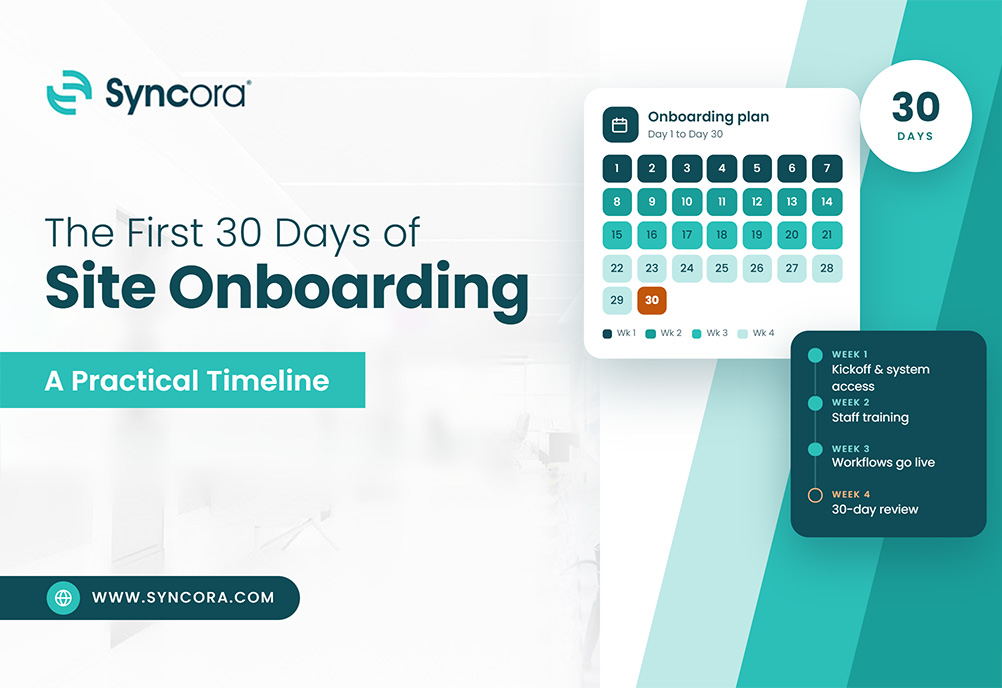
A practical 30-day plan for site onboarding for clinical trials runs in four weekly blocks. Week 1 confirms site details, team, and task owners. Week 2 prepares regulatory forms and collects signatures. Week 3 covers training, access, and visit scheduling. Week 4 closes open gaps, holds the initiation visit, and moves the study forward.
This plan covers the first 30 days of your site’s own prep work. It doesn’t promise activation in 30 days, since contracts, budgets, and IRB approval run on their own timelines.
Key Takeaways
- Four weekly blocks give a 30-day plan its order: site details and owners in week 1, regulatory forms in week 2, training and visits in week 3, and a readiness review in week 4.
- Naming one owner for every task in week 1 gives you a clear person to ask when a step stalls later.
- Signatures depend on other people’s calendars, so start collecting them in week 2 and track each version as you go.
- A week 4 readiness review checks open gaps, unsigned documents, and mandatory tasks before the initiation visit, so the visit confirms the work instead of becoming a scramble.
Your site has been selected for a new study. Great news. Then the quiet part starts: the stretch between “selected” and “ready to enroll,” where forms, signatures, training records, and visits all need to land in the right order. That stretch is the heart of site onboarding for clinical trials, and it rarely follows a neat schedule.
This post lays out a practical 30-day plan, built as four weekly blocks. Week 1 sets owners and site details. Week 2 covers regulatory paperwork. Week 3 handles training, access, and visits. Week 4 closes gaps before the initiation visit.
We’ll also show where Syncora fits in. First, let’s look at why this stretch drags.
Why does site onboarding take so long?
Most of the delay comes from steps that depend on people outside your site.
Here’s where the waiting usually happens:
- Sponsors review documents on their own schedule.
- IRBs often meet on set dates, so a missed submission deadline can push you to the next meeting.
- Contract and budget talks can sit for days while each side checks with legal or finance.
A Tufts Center for the Study of Drug Development benchmark published in 2018 put the time from site identification to startup completion at 31.4 weeks.
That measure starts at site identification, so it covers more than your own team’s tasks. It also shows why site onboarding for clinical trials can feel slow even when your team moves fast.
Meanwhile, your coordinators still have forms to fill and training to schedule, and their regular workload doesn’t pause.
Is 30 days a standard timeline?
No. It’s a planning frame, not a standard.
Your own site activation timeline depends mostly on contracts, budgets, and IRB approval. What you control is the order of your work and who owns each piece.
So, the plan below uses 30 days to sequence that work. Treat it as a draft and adjust it to your study.
What does a 30-day site onboarding plan look like?
It looks like four weekly blocks, each with one job.
Think of it as a planning sequence, not a rulebook. Your study may shift the order a little (contracts rarely follow a calendar). The logic still holds: owners first, paperwork second, training and visits third, review last.
A site onboarding checklist, organized by week.
| Week | Focus | Main output |
|---|---|---|
| 1 | Site details, team, and owners | Complete site record, one owner per task |
| 2 | Regulatory documents and forms | Forms prepared, signatures collected |
| 3 | Training, access, and visits | Training assigned, access set, visits booked |
| 4 | Readiness review | Gaps closed, initiation visit held, study moved forward |
Each block feeds the next. A missing owner in week 1 turns into a missing signature in week 2, so the early weeks matter more than they look.
So, let’s start with week 1, where the groundwork happens.
What should happen in week 1?
Week 1 of site onboarding for clinical trials is for confirming your team, your task owners, and your site details.
It’s quiet work that sets the pace for the rest of the month, since every form and signature needs an owner.
Who owns what?
One named person owns each task, and the PI and sub-investigators come first.
- PI and sub-investigators: Confirm who is on the study and in what role.
- Study team: List everyone else who will work on it.
- Task owners: Give each task one name and one due date.
What goes into the site record?
Your site record covers the basics that clinical trial site setup depends on.
- Site and company details: Name, address, and point of contact.
- Office and hospital details: EMR access and the nearest hospital.
- Space and storage: Exam rooms, visit space, and locked storage.
- Equipment: What you have on site.
In Syncora, you fill in a tabbed site record, and a template sets up the study’s tasks, including mandatory ones.
With the basics in place, the paperwork begins. Week 2 is where it gets busy.
What paperwork comes first in week 2?
Regulatory forms and signatures come first, because they rely on people outside your team. Your team controls how fast a form gets prepared. Someone else’s calendar controls how fast it gets signed. That’s why these are among the first site activation steps to start.
Which forms do sites prepare?
Most sites begin with a core set:
- FDA Form 1572: Names the investigator, sub-investigators, and study sites.
- Financial disclosure forms: Report each investigator’s financial interests.
- Delegation log: Records who on your team does which study task.
- Feasibility questionnaires and other online forms: Sponsors often send these on their own web pages.
How do you keep signatures and versions straight?
Give every document one owner and one current version.
- Track who has signed and who hasn’t.
- Save each revision as a new version, not an overwrite.
- Set a follow-up date, so waiting doesn’t stall week 3.
In Syncora, FormWork AI and FQ Assistant fill forms from details already in the platform, and File Manager tracks versions and signatures. Your team reviews each filled form before it goes anywhere.
Once the paperwork is moving, training and visits come next.
What belongs in week 3: Training, access, and visit planning?
Week 3 covers who gets trained, who gets access, and when the visits happen. This is where site onboarding for clinical trials moves from paperwork to people.
Who needs training and access?
Everyone who touches the study needs training on it, and access only to what their role requires.
- Assign each required training to a named person with a due date.
- Record completion as it happens, so records are ready when a sponsor asks.
- Set access by role, and give people only what their job needs.
When do the visits happen?
Schedule the initiation visit during week 3, along with any pre-study visit (PSV) that’s still outstanding. Both belong to the site initiation process, and both depend on other people’s availability.
- Ask each attendee for open dates, including sponsor and CRO staff.
- Confirm one date and send it to everyone taking part.
- Line up outside partners, like labs or couriers, before the visit.
Once the visits are booked, week 4 checks that nothing slipped.
What should a readiness review cover in week 4?
A readiness review checks four things: open gaps, unsigned documents, overdue tasks, and unfinished mandatory tasks. Run it a few days before the site initiation visit, so you still have time to fix what it finds.
What goes on the review list?
Here’s a short site onboarding checklist for it:
- Documents: Every form signed, with the current version saved.
- Tasks: Nothing overdue, and every mandatory task done.
- Team: Training recorded and access set for each role.
- Visit: Date confirmed with every attendee.
In Syncora, follow-up reminders flag what’s overdue, and mandatory tasks show what’s left before a study moves on.
What happens after the review?
Hold the initiation visit once the list is clear.
If something is still open, log it with an owner and a date, and keep moving. (A short, honest gap list beats a tidy-looking one.) After the visit, move the study to its next phase. That’s the month on paper.
Now that we have covered all the weeks, let’s have a look at what Syncora can do for you.
How can Syncora support the first 30 days?
Syncora keeps the tasks, files, follow-ups, and visits from all four weeks in one place. It’s a platform built for clinical research sites to manage the work that happens before a trial officially begins.
For site onboarding for clinical trials, it keeps your plan next to the people, documents, and dates it depends on.
What does it add across the whole month?
A few features work across all four weeks, not just one.
- A personal task list: Each person sees their own assignments in My Tasks.
- A manager’s view: Progress shows across studies, departments, and sites.
- Reports: The Study Task report shows what’s done, what’s still open, and what’s running behind.
That cross-week view matters for clinical trial site setup, where small gaps in week 1 often resurface in week 3.
Before we wrap up, let’s answer a few questions readers often ask.
Frequently Asked Questions
What is a site initiation visit?
It’s a meeting between your site team and the sponsor or CRO. They review the protocol and confirm the site is ready to enroll. It happens before enrollment starts.
How long does site onboarding for clinical trials take?
It varies widely from study to study. Contracts, budgets, and IRB approval set most of the timeline, while your own prep work runs alongside them. Treat 30 days as a planning frame for your prep work, not a promise.
What are the main site activation steps?
Five steps cover most of it:
- Confirm your team and site details.
- Prepare regulatory documents and collect signatures.
- Complete training and set access.
- Review readiness and close open gaps.
- Hold the initiation visit.
Conclusion
Four weeks, four jobs. Week 1 sets owners and site details, week 2 handles paperwork, week 3 covers training and visits, and week 4 closes the gaps.
Contracts, budgets, and IRBs will keep their own pace, so use the month for what your team controls. That’s the practical core of site onboarding for clinical trials: a clear order, one owner per task, and a short gap list before the visit.
Start with week 1, because every later week leans on it.
If you’d like to see how Syncora keeps those pieces together, reach out to us for a demo.


