

Quick Answer:
Startup cycle time is a key operational measure in clinical research. It tracks how long it takes to move a clinical trial or study site from a defined starting milestone to a specified endpoint, such as site activation or first patient enrollment. For sponsors, contract research organizations (CROs), and research sites, understanding this interval helps reveal where study startup processes are progressing efficiently and where delays are accumulating.
Key Takeaways
- Startup cycle time measures elapsed time between two clearly defined clinical trial startup milestones.
- A study startup timeline should identify key activities, dependencies, owners, and planned completion dates.
- Clinical trial startup metrics should include overall duration as well as milestone-level performance.
- Time to site activation and the first patient in timeline measure different stages and should be tracked separately.
- Startup benchmarks clinical trials teams use must account for study complexity, site characteristics, and consistent metric definitions.
- Study startup KPIs should balance speed with documentation quality, milestone adherence, activation rates, and readiness.
What Is Startup Cycle Time?
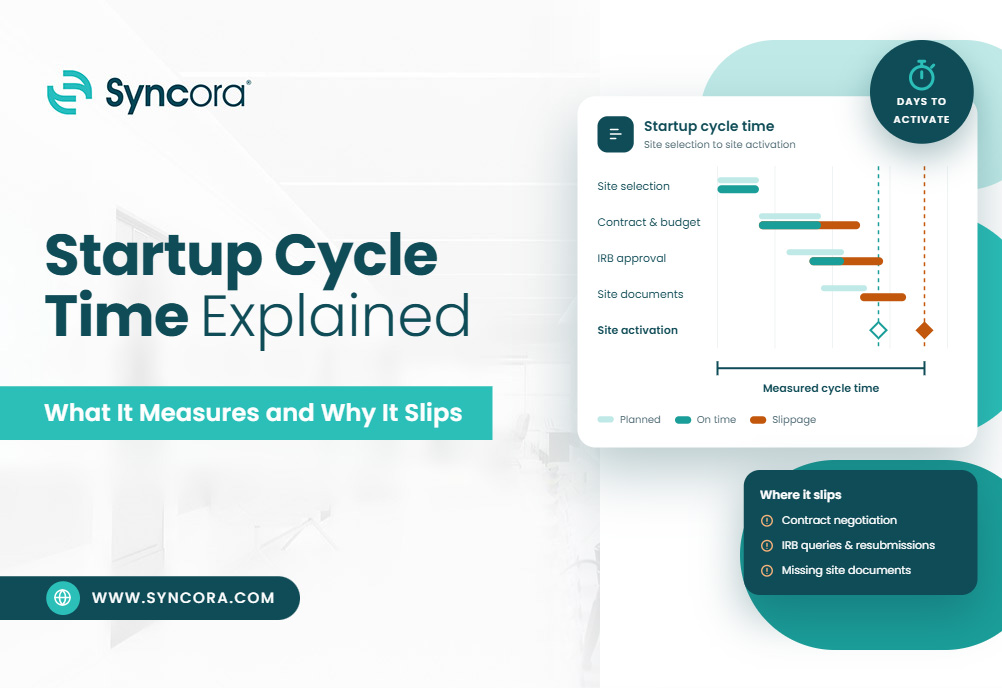
Startup cycle time is the elapsed time between two defined milestones in the preparation of a clinical trial or site. Depending on the measurement, it may cover the period from site selection to site activation, protocol receipt to regulatory submission, or study initiation to first patient enrollment.
It is commonly measured on calendar days or weeks. Sponsors and CROs use it to assess the pace of study startup, identify operational bottlenecks, compare performance across sites or studies, and determine whether planned milestones are being met.
The key is to define the starting point and endpoint consistently. A measurement ending at site activation is not directly comparable to one ending at first patient.
What Does Startup Cycle Time Measure in Clinical Trials?
Clinical trial startup involves several connected activities that must be completed before a site can begin conducting study-related procedures. Depending on the study, these activities may include site feasibility, budget and contract negotiations, ethics committee or institutional review board (IRB) review, essential document collection, staff training, and activation of readiness.
The specific measurement depends on the operational question being asked.
A site may track the interval between receiving a complete regulatory package and submitting it for review. A CRO may monitor the time required to obtain executed agreements across participating sites. Each measurement answers a different question.
- Overall startup duration: How long does the defined startup process take?
- Milestone cycle time: How long does an individual activity take to complete?
- Time in queue: How long does a task wait before someone begins working on it?
- Rework time: How much additional time is required to correct errors or resubmit documents?
- Activation rate: What proportion of selected or initiated sites ultimately become active?
These measures help teams distinguish between slow execution, external dependencies, and avoidable administrative delays.
Understanding the Study Startup Timeline
A study startup timeline maps the activities, dependencies, owners, and milestones required to prepare a study for execution. It provides a working plan for sponsors, CROs, and sites to coordinate their responsibilities. If you’re new to the process, our step-by-step guide to starting a clinical study walks through it end to end.
Although workflows differ by protocol and jurisdiction, the process commonly includes the following stages.
1. Site Identification and Feasibility
Sponsors and CROs identify potential sites and assess whether they can conduct the study successfully.
Feasibility activities may examine patient population access, investigator experience, staffing, facilities, equipment, competing studies, and the site’s ability to meet protocol requirements.
Delays can occur when feasibility questionnaires remain incomplete; site capabilities are not assessed promptly, or important operational constraints emerge after site selection.
2. Budget and Contract Negotiations
Financial and contractual discussions establish the terms under which the study will be conducted.
Negotiations may involve per-participant costs, study procedures, payment schedules, insurance requirements, and institutional contract terms. Clinical trial budget planning done early can reduce back-and-forth at this stage.
A study startup time can slip when the sponsor and site work from different assumptions; review responsibilities are unclear, or contract changes repeatedly move between stakeholders. Communication gaps between sponsors, CROs, and sites are a common cause.
3. Regulatory and Ethics Submissions
Required documents must be prepared, reviewed, and submitted to the relevant regulatory authorities and ethics review bodies, as applicable.
The exact requirements depend on the study, country, and regulatory framework. In the United States, IRB review and applicable FDA requirements are important parts of many clinical trial startup processes.
Incomplete submissions, outdated documents, inconsistent protocol information, and delayed responses to review comments can add time to this stage. See regulatory and documentation hurdles in study startup for what sites need to know.
4. Essential Document Collection and Staff Readiness
The site and study team prepare required documentation, confirm responsibilities, and complete applicable training.
Depending on the trial, this can involve investigator credentials, financial disclosures, delegation records, training documentation, laboratory arrangements, and other essential records.
Starting document collection late can create a bottleneck near the planned activation date. A practical 30-day site onboarding timeline can help teams sequence this work earlier.
5. Site Activation
Site activation occurs when the sponsor or its authorized process confirms that the site has met the applicable requirements to begin study activities or enrollment.
The required conditions vary by study. Relevant approvals, contracts, documentation, training, and operational readiness must be in place before the site conducts activities that require them.
Activation should therefore represent verified readiness, not simply the completion of an administrative milestone.
6. First Patient in
First patient (FPI) is a separate milestone that generally refers to the first participant enrolled in a study, although organizations should specify whether they define it by consent, screening, or enrollment.
The time between activation and FPI can be affected by recruitment planning, referral pathways, participant availability, and the study’s eligibility criteria.
For this reason, completing startup efficiently does not automatically mean a site will enroll its first participant quickly.
Clinical Trial Startup Metrics That Matter
Tracking clinical trial startup metrics helps teams identify where time is spent and which activities require attention.
Each metric needs clearly defined start and end dates. A peer-reviewed analysis of startup processes supports examining individual intervals rather than relying only on total duration.
Why Is Overall Cycle Time Not Enough?
A site that takes 120 days to activate may have experienced contract delays, incomplete documents, or lengthy review cycles. The total duration does not identify which issue caused the delay.
Two sites can have identical startup durations but require different solutions. Tracking individual milestones helps teams target the actual bottleneck instead of applying the same corrective action everywhere.
Time to Site Activation: How Should It Be Measured?
Time to site activation measures the elapsed period between a defined starting milestone and the documented activation date.
The starting point may be site selection, receipt of the final protocol, or receipt of a complete startup package. The endpoint should be defined consistently across the studies being compared.
Teams should document:
- The exact start and end events.
- Whether calendar days or business days are used.
- How paused, withdrawn, or inactive sites are handled.
- Which study types and site categories are included.
- How reopened or corrected submissions affect the measurement.
Mean vs. Median Startup Duration
The mean is the average of all measured durations, while the median is the middle value when durations are ordered.
A few unusually long delays can raise the mean. Reporting both the mean and median, alongside the number of sites measured, can give teams a more complete picture of performance.
First Patient in Timeline: Why Activation Is Only One Milestone
The first patient in timeline extends beyond startup administration to include the site’s initial recruitment and enrollment activities.
After activation, the team may still need to establish referral pathways, identify potential participants, assess eligibility, and coordinate screening visits.
Factors that can affect FPI include:
- Participant availability and eligibility criteria.
- Recruitment and referral processes.
- Competing studies and local recruitment conditions.
- Site experience with the therapeutic area.
- Screening requirements and appointment availability.
If activation is on schedule, but FPI is delayed, teams may need to review recruitment readiness rather than focus solely on document processing. Tracking both milestones helps distinguish startup problems from enrollment challenges. Tools like Calendax, for AI-powered clinical trial prescreening, can support the recruitment side.
Startup Benchmarks Clinical Trials Teams Should Use
Startup benchmarks clinical trials teams use should reflect study complexity, site characteristics, regulatory requirements, and comparable historical performance.
There is no single timeline appropriate for every study. A trial at an experienced site may have different requirements from a multinational study involving complex contracts, specialized facilities, or multiple review processes.
Organizations can develop practical benchmarks using three sources:
- Historical performance: Compare completed studies with similar characteristics.
- Internal targets: Set realistic goals based on staffing, resources, and process capacity.
- External comparisons: Use published research or industry datasets with comparable definitions.
Always confirm what the benchmark measures. Site selection to activation is not equivalent to protocol receipt to activation.
Benchmarks should support planning and investigation, not encourage teams to rush required reviews or activate sites before they are ready.
What Should Sponsors and CROs Track?
Effective study startup KPIs measure speed, quality, predictability, and readiness. Relying only on elapsed days may overlook errors or incomplete requirements.
1. Milestone Cycle Time
Track the duration of activities such as feasibility completion, budget agreement, and contract execution.
2. Milestone Adherence
Measure the proportion of milestones completed by their planned dates.
3. First-Pass Document Acceptance
Track the percentage of submissions accepted without corrections or resubmissions.
4. Site Activation Rate
Calculate the percentage of selected or initiated sites that become active within a defined period.
5. Overdue Task Rate
Measure the proportion of open tasks that have passed their assigned due dates.
6. Activation-to-FPI Interval
Measure the time between activation and the study defined first-participant milestone.
Together, these study startup KPIs give sponsors and CROs a more balanced view of performance. Definitions and reporting periods should remain consistent, so comparisons are meaningful.
Turning Startup Data into Better Decisions
Startup data becomes useful when it helps teams understand where delays occur, and which changes can address them.
Sponsors, CROs, and research sites can use milestone-level reporting to improve resource allocation, set realistic expectations, and distinguish preventable delays from necessary review time.
A practical dashboard should connect overall duration with task ownership, milestone performance, activation, and FPI. This provides a more complete view than a single headline number. Syncora’s platform offers progress dashboards and task tracking built for this purpose.
Final Thoughts
Startup cycle time helps clinical operations teams understand how efficiently a study moves from a defined starting point to a specific milestone. However, total duration alone cannot explain why a timeline slips.
Tracking individual milestones, monitoring meaningful KPIs, and comparing similar studies can help sponsors and CROs identify bottlenecks. Standardized workflows, clear ownership, timely communication, and appropriate parallel processing may reduce avoidable delays while maintaining required oversight.
The goal is not simply to activate sites sooner. It is to prepare them properly so studies can move into execution with fewer preventable operational setbacks. Ready to see how it works? Book a demo with Syncora.
Frequently Asked Questions
What is startup cycle time in clinical trials?
It is the elapsed time between two defined startup milestones, such as site selection and activation. The endpoints should always be stated clearly.
What is the difference between startup cycle time and site activation time?
Startup cycle time is a general term for the duration between defined milestones. Site activation time specifically measures the interval leading to activation. They are equivalent only when they use the same endpoints.
What is a typical study startup timeline?
There is no universal duration. Study design, site experience, contracting, regulatory requirements, and operational readiness all influence the timeline. Historical data from comparable studies provides a more useful planning baseline.


